
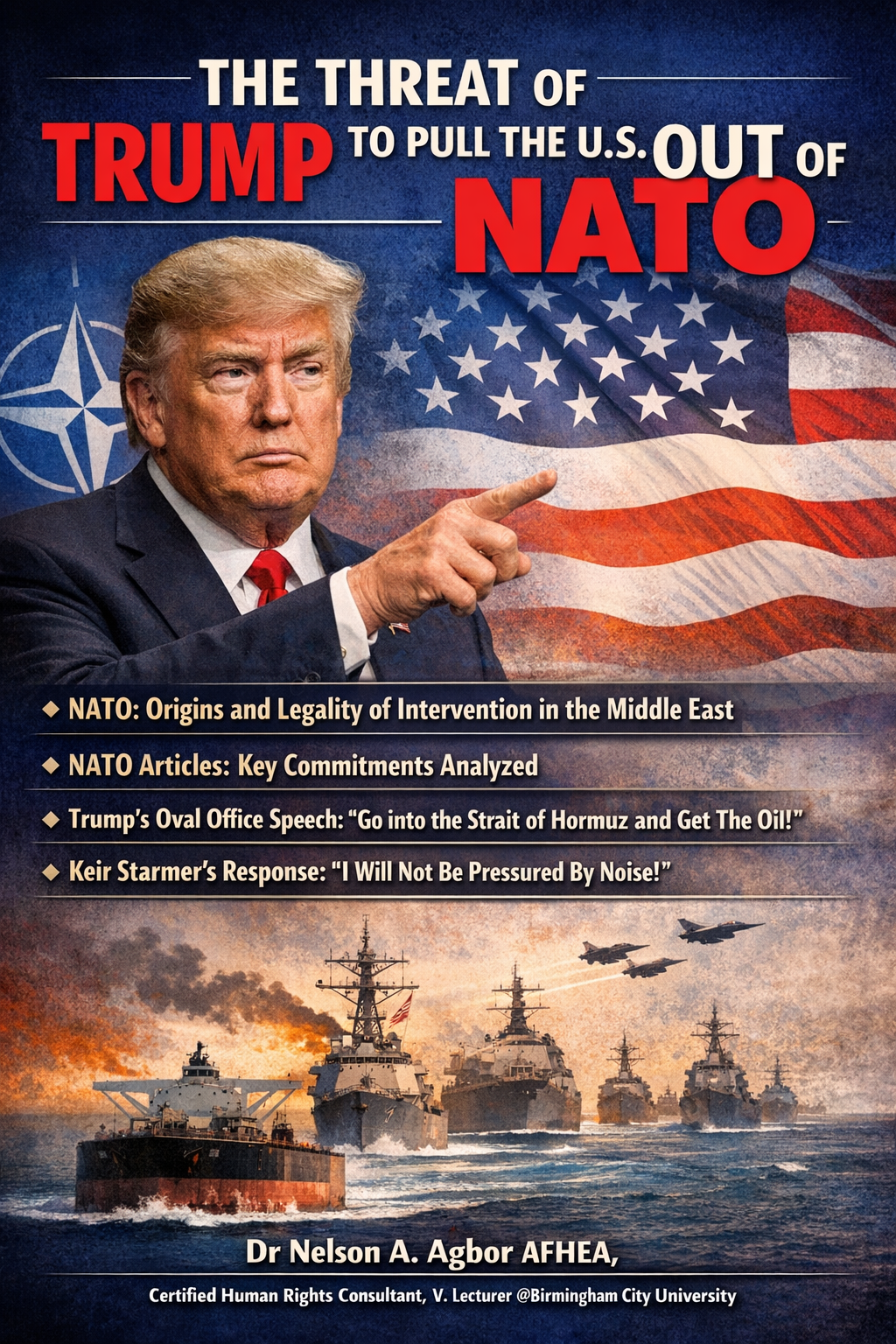
The renewed threat by Donald Trump to withdraw the United States from NATO must be viewed within both the alliance’s foundational principles and the evolving constitutional and geopolitical constraints that influence U.S. involvement. NATO was created in 1949 as a collective defence pact primarily aimed at deterring Soviet expansionism during the early Cold War. Its central justification is embedded in Article 5 of the North Atlantic Treaty, which states that an armed attack against one member shall be considered an attack against all. This mutual defence clause is explicitly defensive, reflecting the alliance’s original role as a stabilising force rather than a tool for discretionary or offensive warfare.
The validity of Trump’s current threat is legally uncertain but politically limited. While Article 13 of the North Atlantic Treaty allows withdrawal with one year’s notice, recent U.S. legislation demands congressional approval, specifically a two-thirds Senate vote, for any such exit. This creates a constitutional conflict between executive power over foreign affairs and legislative control of treaty commitments. Although some legal interpretations, particularly those promoted during Trump’s first administration, suggest the president might have unilateral withdrawal powers, the statutory ban on funding or implementing withdrawal complicates a simple exit. Therefore, the threat is more likely a coercive diplomatic signal rather than an immediately actionable policy.
The current crisis raises important questions about NATO’s role in so-called “wars of choice,” particularly the U.S.-led conflict with Iran. NATO’s legal framework does not obligate member states to support offensive operations unless an armed attack activates Article 5. In fact, the alliance was not formally invoked concerning the Iran conflict, which was initiated without collective consultation. Instead, Article 4 permits allies to consult when security concerns arise, but it does not require military involvement. This distinction is vital: NATO is not a supranational military authority capable of forcing participation in discretionary conflicts. The refusal of European allies to support U.S. actions in the Strait of Hormuz is therefore consistent with both the treaty and established state practice.
Trump’s Oval Office address must be understood within this legal context. In that speech, he claimed that countries reliant on Middle Eastern oil should “grab it and cherish it,” effectively urging allied nations to take responsibility for securing the Strait of Hormuz. This rhetoric aligns with his broader critique of NATO as an unequal burden-sharing arrangement. He criticised allies for not supporting U.S. efforts to reopen the strait through which about one-fifth of global oil passes and linked their inaction to rising global energy prices. The speech, while presented as strategic realism, carries a notably transactional tone, redefining alliance commitments in economic rather than legal or security terms.
Empirically, the allied response highlights the limits of such pressure. Several NATO members, including the United Kingdom, chose not to participate in the Iran campaign, framing it as a conflict beyond their national interest and outside NATO’s defensive mandate. This resistance reflects not only legal orthodoxy but also a broader reassessment of European strategic autonomy. Trump’s portrayal of NATO as a “paper tiger” seems rhetorically exaggerated; the alliance continues to operate effectively in its core deterrence role, especially concerning Russia and collective defence commitments.
Within this context, Keir Starmer’s stance warrants particular attention. Starmer’s refusal to be drawn into the conflict, asserting that it is “not our war,” exemplifies disciplined adherence to both principles of international law and alliance norms. His resistance to what he described as external “noise” or pressure can be seen as a reaffirmation of sovereign decision-making within multilateral frameworks. Far from undermining NATO, such restraint reinforces its legal integrity by maintaining the distinction between collective defence and discretionary military engagement. In this respect, Starmer’s position is not merely politically prudent but also jurisprudentially coherent, upholding the alliance’s founding principles amid significant geopolitical pressure.
Dr Nelson A. Agbor AFHEA
Certified Human Rights Consultant
V. Lecturer @Birmingham City University.




