
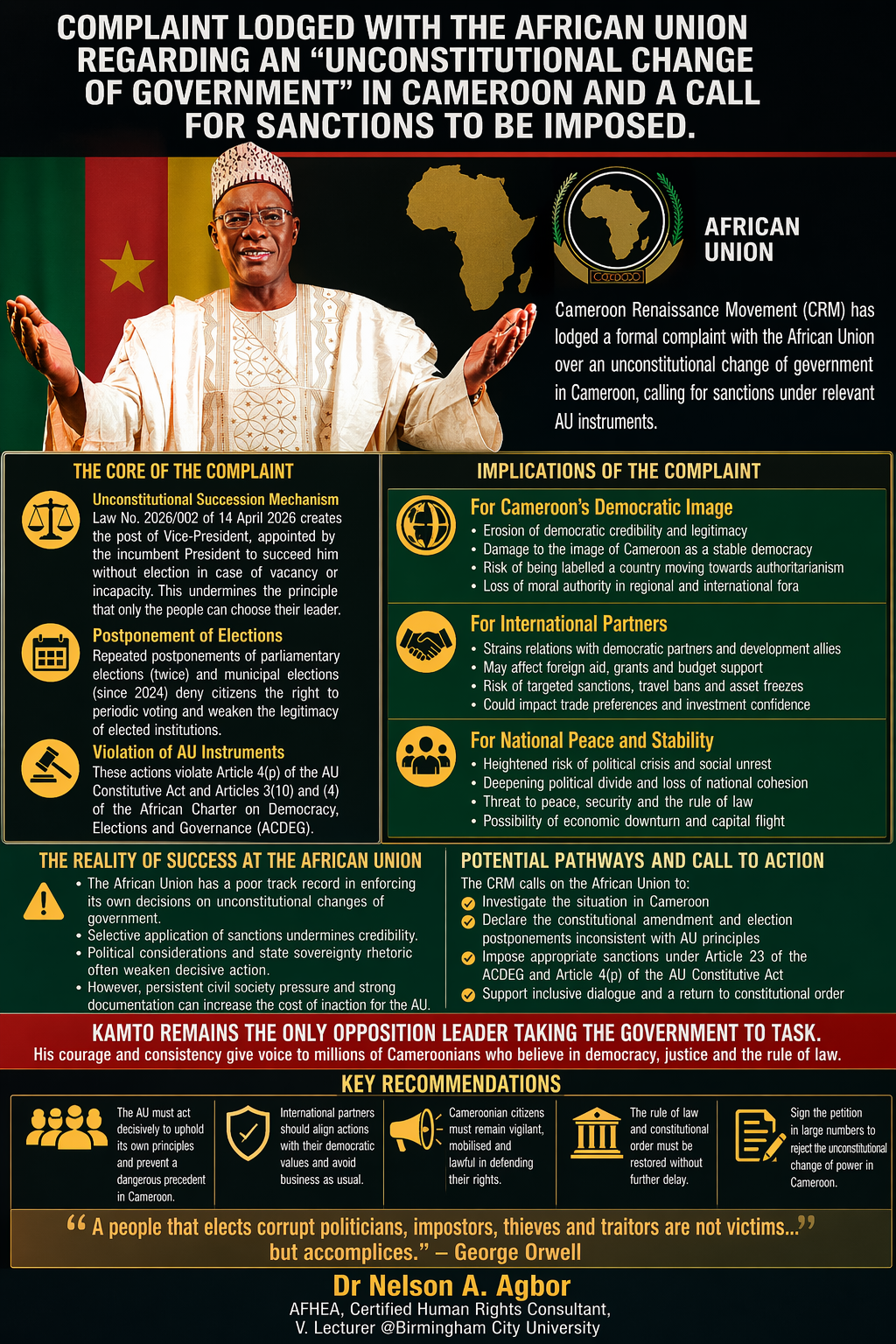
The complaint submitted by the Cameroon Renaissance Movement (CRM) to the African Union (AU) regarding an alleged “unconstitutional change of government” in Cameroon raises complex legal, institutional, and political questions that extend beyond the immediate national context. At its core, the complaint invokes continental norms embedded in the AU’s governance architecture, particularly the prohibition of unconstitutional changes of government and the commitment to democratic constitutionalism. Framing the situation as a “constitutional coup” is especially significant, as it situates the dispute within evolving debates about legality versus legitimacy in constitutional reform processes.
The CRM’s legal argument relies heavily on the provisions of the African Charter on Democracy, Elections and Governance (ACDEG) and the AU Constitutive Act, both of which articulate a normative rejection of unconstitutional power transitions. By highlighting Article 4(p) of the Constitutive Act and Articles 3 and 4 of ACDEG, the complaint seeks to show that formal constitutional amendments can still violate substantive democratic principles if they undermine electoral sovereignty. This interpretation aligns with a broader jurisprudential trend in African constitutional law that scrutinises amendments for their democratic integrity rather than merely their procedural validity.
A central issue raised is the introduction of a Vice-President appointed by the sitting President, with authority to complete a presidential term in the event of a vacancy. From a constitutional theory perspective, this mechanism shifts the locus of democratic legitimacy by enabling indirect succession without electoral endorsement. The CRM argues that this undermines the principle of popular sovereignty, a cornerstone of modern constitutional democracies. Whether this argument is persuasive depends on how one interprets the balance between constitutional flexibility and entrenched democratic norms.
Equally significant is the allegation of repeated postponements of parliamentary and municipal elections. Electoral periodicity is a fundamental element of representative democracy, and its disruption can erode institutional legitimacy.
The CRM’s position suggests that prolonged mandate extensions effectively suspend citizens’ political rights, thereby contravening both domestic constitutional guarantees and international obligations. This aspect of the complaint broadens the issue from a single constitutional amendment to a systemic pattern affecting democratic governance.
Despite the complaint’s legal sophistication, its prospects within the AU framework remain uncertain. The AU has historically been inconsistent in enforcing its norms against unconstitutional changes of government, particularly when such changes occur through ostensibly legal mechanisms rather than overt military coups. Institutional constraints, including political considerations among member states and the principle of non-interference, often limit the AU’s willingness to impose sanctions. This perceived weakness directly affects the likelihood of meaningful action in the Cameroonian case.
The question of enforcement is further complicated by the AU’s reliance on consensus and diplomatic engagement. Even when violations are identified, imposing sanctions requires political will, which may be lacking, particularly in cases involving entrenched regimes. Consequently, the CRM’s appeal may serve more as a normative and symbolic act than as a catalyst for immediate institutional intervention. It nevertheless contributes to the gradual development of accountability norms within the continental system. Internationally, the complaint has implications for Cameroon’s democratic image. Allegations of constitutional manipulation and electoral postponement can affect perceptions among bilateral partners, multilateral institutions, and investors. States that position themselves as adhering to democratic governance standards often face reputational costs when such claims gain traction. While these effects may not translate into immediate policy shifts by international partners, they can influence long-term diplomatic and economic engagement.
For international partners, the situation poses a dilemma between strategic interests and normative commitments. Many external actors continue to cooperate with Cameroon on security, economic, and regional stability grounds. However, ongoing allegations of democratic backsliding may generate pressure, particularly from civil society and legislative bodies in partner countries, to reassess these relationships. This dynamic underscores the interconnectedness of domestic governance and international legitimacy. On the domestic front, the complaint reinforces Maurice Kamto’s standing as a central figure in opposition politics. By engaging both national and international legal mechanisms, Kamto and the CRM project project an image of institutional contestation rather than purely rhetorical opposition. This approach distinguishes their strategy from more fragmented or less legally grounded forms of opposition activity, potentially consolidating their role within the political landscape.
The assertion that Kamto remains the only opposition leader actively challenging the government highlights a broader issue of opposition cohesion and effectiveness in Cameroon. Whether or not this claim is empirically exhaustive, the CRM’s initiative exemplifies a form of legal activism that seeks to leverage international norms to influence domestic politics. The broader implication is that opposition strategies may increasingly rely on transnational legal and institutional frameworks when domestic avenues appear constrained, thereby reshaping the contours of political contestation in the country.
Dr Nelson A. Agbor AFHEA
Certified Human Rights Consultant
V. Lecturer @Birmingham City University.




