
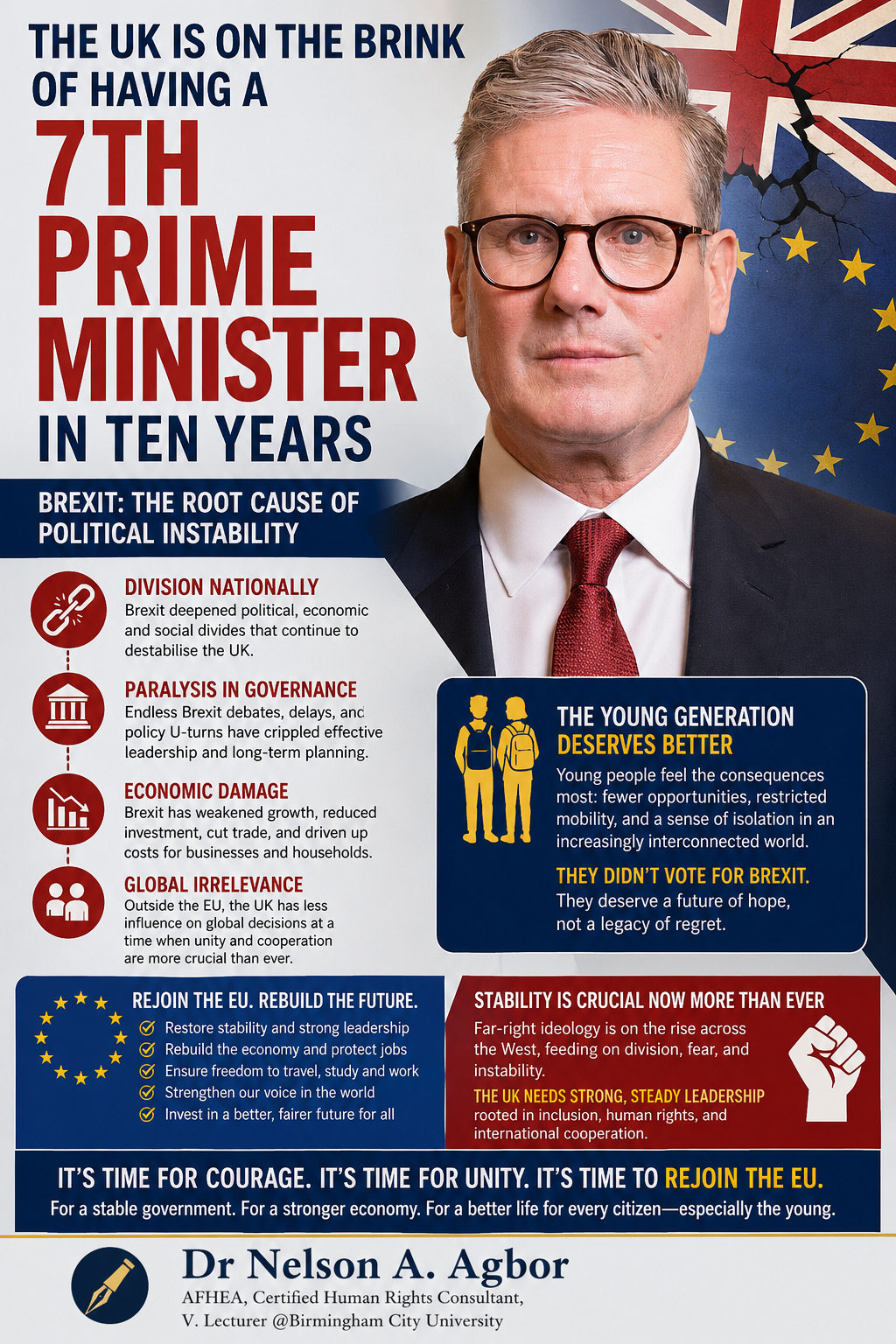
The United Kingdom stands at a remarkable and troubling political juncture. Less than a decade after the 2016 Brexit referendum, the country is on the brink of its seventh Prime Minister in 10 years. Such executive turnover is unusual for a mature parliamentary democracy traditionally celebrated for its political stability and constitutional continuity. The rapid succession of leaders from David Cameron to Theresa May, Boris Johnson, Liz Truss, Rishi Sunak, and Keir Starmer reflects deeper structural tensions within British politics. While leadership changes are an inherent feature of democratic governance, the frequency and intensity of recent transitions suggest a crisis of political direction. At the heart of this instability lies Brexit, a political project whose consequences continue to shape the United Kingdom’s domestic governance, economic performance, and international standing.
Brexit was one of the most consequential political decisions in modern British history. The referendum exposed profound divisions within British society over sovereignty, immigration, identity, and the country’s place in Europe. Rather than resolving these questions, however, the vote intensified them. David Cameron resigned immediately after the referendum result, while Theresa May’s premiership became consumed by the near-impossible task of reconciling competing visions of Brexit among Parliament and the electorate. Her eventual resignation illustrated how Brexit had evolved from a policy issue into an existential challenge for British governance. The inability of successive governments to formulate a broadly acceptable Brexit settlement demonstrated the deep fractures the referendum had unleashed.
The premiership of Boris Johnson initially appeared to offer a resolution to the Brexit impasse. Johnson secured a substantial parliamentary majority in 2019 by promising to “Get Brexit Done.” Yet the apparent political victory concealed enduring structural difficulties. Once the withdrawal process was formally completed, the practical consequences of Brexit became increasingly visible. Trade disruptions, labour shortages in key sectors, challenges in Northern Ireland, and reduced economic growth relative to projected trends generated persistent political pressures. Johnson’s administration ultimately collapsed under the weight of scandals and internal party conflict. Still, these controversies occurred within a broader context in which Brexit had fundamentally altered political expectations and intensified ideological divisions within the governing Conservative Party.
The brief premiership of Liz Truss further illustrated the fragility of Britain’s political environment. Her administration lasted only weeks before market turmoil, triggered by unfunded fiscal proposals, undermined investor confidence and forced her resignation. Although the immediate causes of her downfall were economic rather than directly linked to Brexit, the broader economic context cannot be ignored. Britain’s post-Brexit economic landscape had already constrained policy flexibility and heightened sensitivity to financial uncertainty. The Truss episode demonstrated how a political system weakened by years of Brexit-related conflict had become increasingly vulnerable to shocks, with profound implications for public confidence in government institutions.
The subsequent leadership of Rishi Sunak sought to restore stability and credibility. Nevertheless, Sunak inherited an economy grappling with inflation, sluggish growth, pressures on public services, and declining public trust. Many of these challenges had global dimensions, including the effects of the COVID-19 pandemic and international economic turbulence. However, Brexit remained a significant factor. Numerous studies have suggested that the UK’s departure from the European Union has imposed costs on trade, investment, and labour mobility. As a result, Brexit has continued to influence political discourse, shaping public evaluations of government performance and contributing to the perception that Britain remains trapped in a cycle of unresolved post-referendum adjustment.
The election of Keir Starmer marked a significant shift in British politics, yet it did not necessarily signal the end of the instability that has characterised the past decade. Starmer inherited a political system marked by voter volatility, declining party loyalties, regional fragmentation, and widespread dissatisfaction with established institutions. The prospect of another leadership transition in the United Kingdom reflects how precarious the office of Prime Minister has become. Unlike earlier periods in British history, when leaders often governed for extended periods, contemporary prime ministers operate in an environment of heightened scrutiny, polarised debate, and diminished public patience. Brexit has been a central catalyst of this new political reality.
Given these developments, it is increasingly legitimate to reconsider Britain’s relationship with the European Union. While immediate re-entry into the EU remains politically complex, the discussion itself should no longer be considered politically taboo. Its advocates presented Brexit as a pathway to greater sovereignty, economic opportunity, and national renewal. Yet for many citizens, particularly younger generations, the experience has been marked by diminished opportunities for travel, study, work, and cultural exchange. The loss of automatic freedom of movement has had significant symbolic and practical consequences for a generation that came of age in an interconnected Europe. Re-engagement with European institutions could therefore be seen not merely as an economic calculation but as a broader strategic effort to reconnect Britain with its natural geopolitical and cultural environment.
Young people arguably have the most at stake in this debate. Surveys consistently show that younger voters are significantly more supportive of remaining in the European Union than older voters. Many view Brexit as having restricted their future opportunities in a world where global mobility, international collaboration, and transnational networks increasingly define economic success. In an era characterised by globalisation, digital connectivity, and multinational cooperation, isolationist tendencies may place the United Kingdom at a competitive disadvantage. Reconsidering closer integration with Europe could offer younger citizens expanded educational, professional, and cultural opportunities while helping to restore a sense of international engagement that many believe has been diminished since Brexit.
The need for political stability is particularly urgent in the broader international context. Across much of the Western world, far-right movements have gained prominence by capitalising on economic insecurity, cultural anxieties, and public distrust of political institutions. From North America to continental Europe, nationalist and populist narratives have reshaped political discourse and challenged liberal democratic norms. Political instability often creates fertile ground for such movements, as frustrated citizens seek alternatives to established parties and institutions. The United Kingdom is not immune to these dynamics. Sustained governmental instability risks deepening public cynicism and creating opportunities for more extreme political forces to expand their influence.
In conclusion, the prospect of a seventh Prime Minister in ten years is a powerful symbol of the political turbulence that has defined contemporary Britain. While numerous factors have contributed to this instability, Brexit remains the most significant and enduring catalyst. The referendum transformed the political landscape, fragmented traditional alliances, and created challenges that continue to shape governance and public life. As Britain confronts economic uncertainty, social division, and a changing global order, policymakers must engage seriously with questions about the country’s future relationship with Europe. Greater stability, renewed international cooperation, and a commitment to opportunities for younger generations may prove essential if the United Kingdom is to overcome the divisions of the Brexit era and chart a more prosperous and cohesive path.
Dr Nelson A. Agbor AFHEA
Certified Human Rights Consultant
V. Lecturer @Birmingham City University.




