
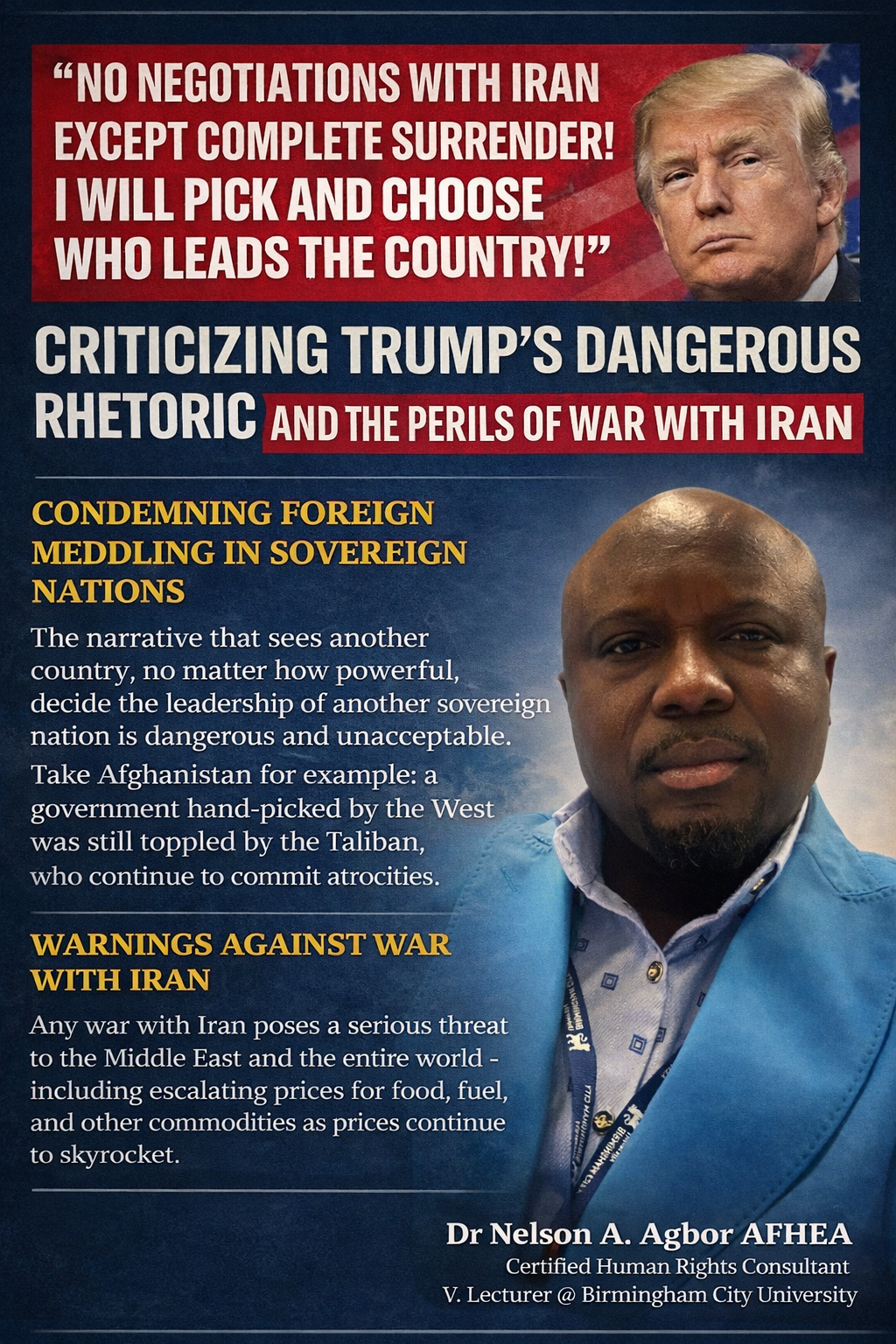
Recent declarations by U.S. President Donald Trump regarding Iran mark a significant escalation in geopolitical rhetoric and a concerning resurgence of interventionist discourse. Trump publicly stated that there would be no negotiations with Iran except for its “unconditional surrender,” and suggested that following such surrender, the United States and its allies would participate in selecting “acceptable” leaders for the country. These statements imply not only military confrontation but also the external appointment of political leadership within a sovereign state. Such rhetoric challenges the core principles of sovereignty and self-determination that underpin the modern international system and risks normalising a doctrine that authorises powerful states to reshape governments abroad.
The idea that one country can “pick and choose” another’s leadership undercuts international norms established since the mid-twentieth century, especially those formalised in the United Nations system. The principle of sovereign equality affirms that all states have the right to determine their political systems without external interference. When major powers suggest that regime change should be imposed from outside, they implicitly legitimise coercive geopolitical hierarchies rather than rules-based governance. Trump’s framing, therefore, is not merely a tactical diplomatic stance; it reflects a narrative that diminishes respect for national autonomy and sets a precedent where powerful actors justify intervention as political engineering.
Historical experience strongly warns against such approaches. The example of Afghanistan demonstrates the limits of externally built political systems. Following the 2001 U.S. intervention, Western powers supported a government whose leadership and institutional framework were heavily influenced by external actors. Despite two decades of international military presence and substantial financial aid, that state collapsed swiftly in 2021 when the Taliban took power. The outcome showed that governments perceived as externally imposed often struggle to gain legitimacy or resilience. Furthermore, the aftermath has been marked by serious human rights concerns under Taliban rule, emphasising that externally driven political restructuring does not guarantee stability, democracy, or protection for civilians.
A continued war with Iran would also have significant economic and humanitarian consequences that extend well beyond the Middle East. The ongoing conflict has already impacted global energy markets, with oil prices rising amid fears of disruptions to the Strait of Hormuz, a crucial maritime route through which approximately 20% of the world’s oil supply passes. Analysts warn that lengthy disruptions could cause global inflationary shocks and raise the costs of fuel, food, and essential goods worldwide. Early signs indicate that the crisis has led to increases in petrol and grocery prices as supply chains become strained. In an interconnected global economy, regional conflicts swiftly become global economic pressures that disproportionately affect vulnerable populations.
For these reasons, the rhetoric of unconditional surrender and externally imposed leadership is highly concerning. It indicates a shift towards more aggressive war objectives and a retreat from diplomatic negotiation. Such a narrative not only risks intensifying a devastating regional conflict but also endangers the wider international order by normalising the idea that sovereignty can be superseded by military force. The lessons of recent history, from Afghanistan to other externally orchestrated political changes, show that stability cannot be enforced from abroad or through air strikes. In a time already characterised by economic instability and geopolitical tensions, pursuing conflict with Iran would jeopardise both regional stability and global prosperity, highlighting the urgent need for diplomacy over coercive regime change.
Dr Nelson A. Agbor AFHEA,
Certified Human Rights Consultant,
V. Lecturer @Birmingham City University.




