
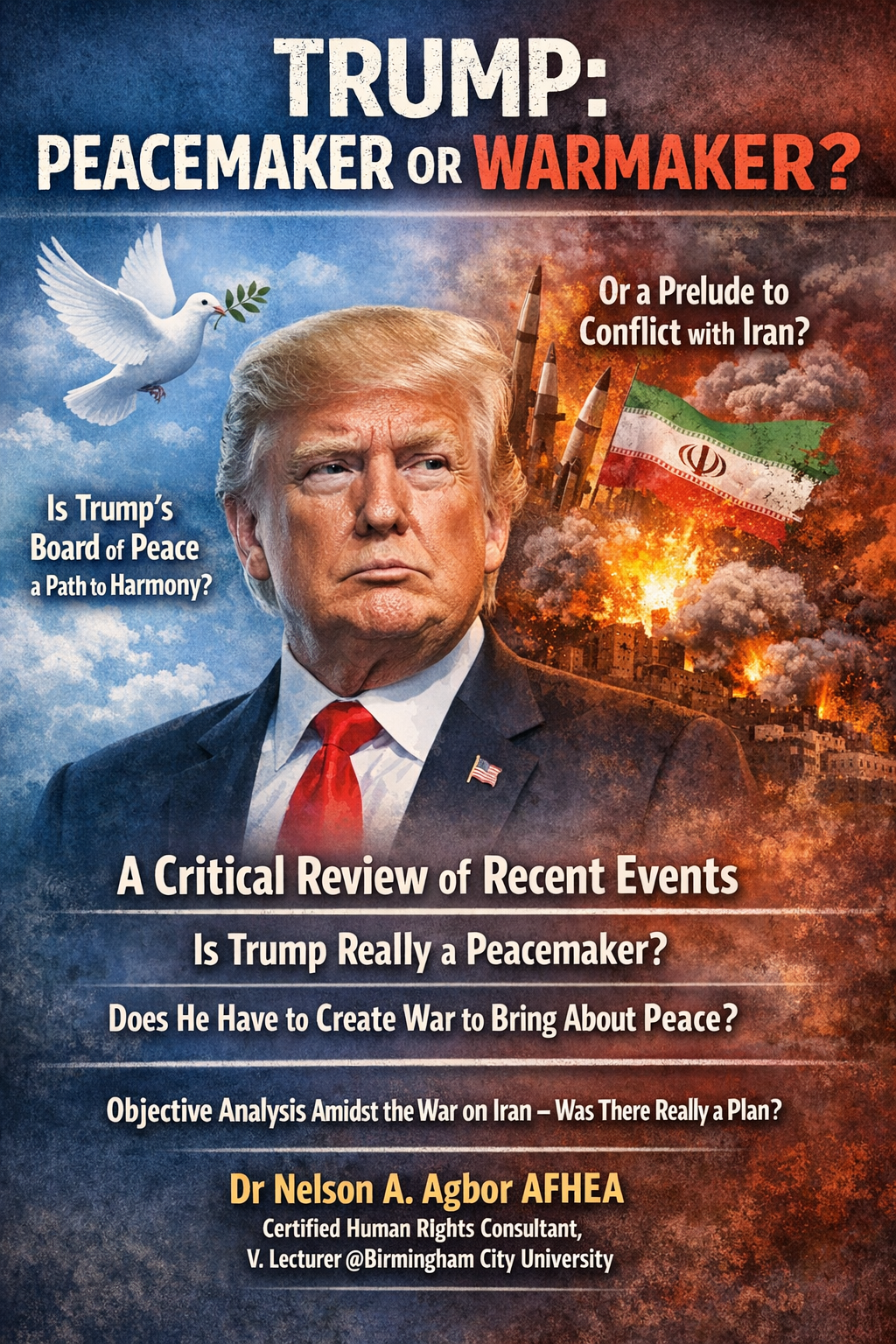
The establishment of the Board of Peace by Donald Trump in 2025–2026 was presented as an international initiative aimed at promoting peacebuilding, reconstruction, and stabilisation in regions affected by conflict. The organisation was originally linked to a plan for post-war governance and rebuilding in Gaza and invited dozens of states to participate, with permanent membership requiring a substantial financial contribution. Trump positioned the initiative as a potential alternative or complement to existing international peace institutions, highlighting its role in maintaining global stability and overseeing peacekeeping efforts. However, the initiative quickly became embroiled in controversy due to the administration’s concurrent military stance towards Iran, which culminated in coordinated U.S.–Israeli strikes targeting Iranian leadership and military infrastructure in early 2026. This juxtaposition raises a key question: can a leader advocating for a global “board of peace” simultaneously engage in aggressive military actions while sustaining credibility as a peacemaker?
Supporters of Trump’s strategy argue that his actions adhere to the long-standing doctrine of “peace through strength.” According to this view, decisive military action against perceived threats like Iran’s alleged nuclear and missile programmes is necessary to deter larger conflicts and ultimately maintain stability. U.S. officials defending the campaign have portrayed the strikes against Iran as preventive measures aimed at avoiding future war and reducing the risk of nuclear proliferation in the Middle East. In this interpretation, the Board of Peace and military operations are not mutually exclusive but complementary: force is employed to eliminate threats. Simultaneously, the Board provides the institutional framework for post-conflict reconstruction and diplomacy. Historically, similar reasoning has been used to justify military interventions that claim to create conditions conducive to peace negotiations.
Nevertheless, critics argue that the timing and scale of the Iran strikes undermine the legitimacy of the Board of Peace initiative. Observers note that the military campaign, including extensive strikes and the killing of high-ranking Iranian officials, has sparked significant legal and political controversy, particularly because Congress did not formally declare war and the operation may exceed presidential authority under U.S. law. International actors have also questioned the precedent of preventive warfare and warned that such actions risk destabilising the global order. From this perspective, launching a peace organisation while simultaneously escalating a major regional conflict creates a contradiction that weakens claims of genuine peace leadership. The suspension of discussions about the Board of Peace by some participating states following the outbreak of the Iran conflict illustrates how military escalation can disrupt diplomatic initiatives associated with the organisation.
A more profound analytical question concerns whether institutions like the Board of Peace need ongoing conflicts to justify their existence. In theory, peacekeeping organisations are meant to address conflicts during or after hostilities, offering mediation, stabilisation forces, and reconstruction programmes. Therefore, the presence of conflict does not necessarily mean that the institution’s founder seeks war; rather, peace organisations often emerge precisely because war exists. However, critics argue that when the same political leadership both initiates military escalation and controls the peace institution, a conflict of interest may develop. Given that the Board of Peace is led by Trump as chairman and endowed with significant centralised authority, some analysts are concerned that the institution might function more as a geopolitical instrument than as a neutral mediator. than as a neutral mediator.
In conclusion, whether Trump can truly be regarded as a peacemaker largely depends on how one interprets the connection between military force and diplomacy. Supporters claim that strategic deployment of force can lead to lasting peace and that the Board of Peace provides a mechanism for reconstruction and managing conflicts. Critics argue that initiating or expanding wars while advocating for peace institutions creates a structural contradiction that weakens the credibility of those institutions. Objectively, the evidence indicates that Trump’s approach combines military coercion with institutional peacebuilding—a strategy aligned with “peace through strength” but highly debated. The success or failure of the Board of Peace as a genuine peace instrument will probably hinge on whether it can operate independently of ongoing military actions and show measurable conflict-resolution results.
Dr Nelson A. Agbor AFHEA
Certified Human Rights Consultant
V. Lecturer @Birmingham City University.




