
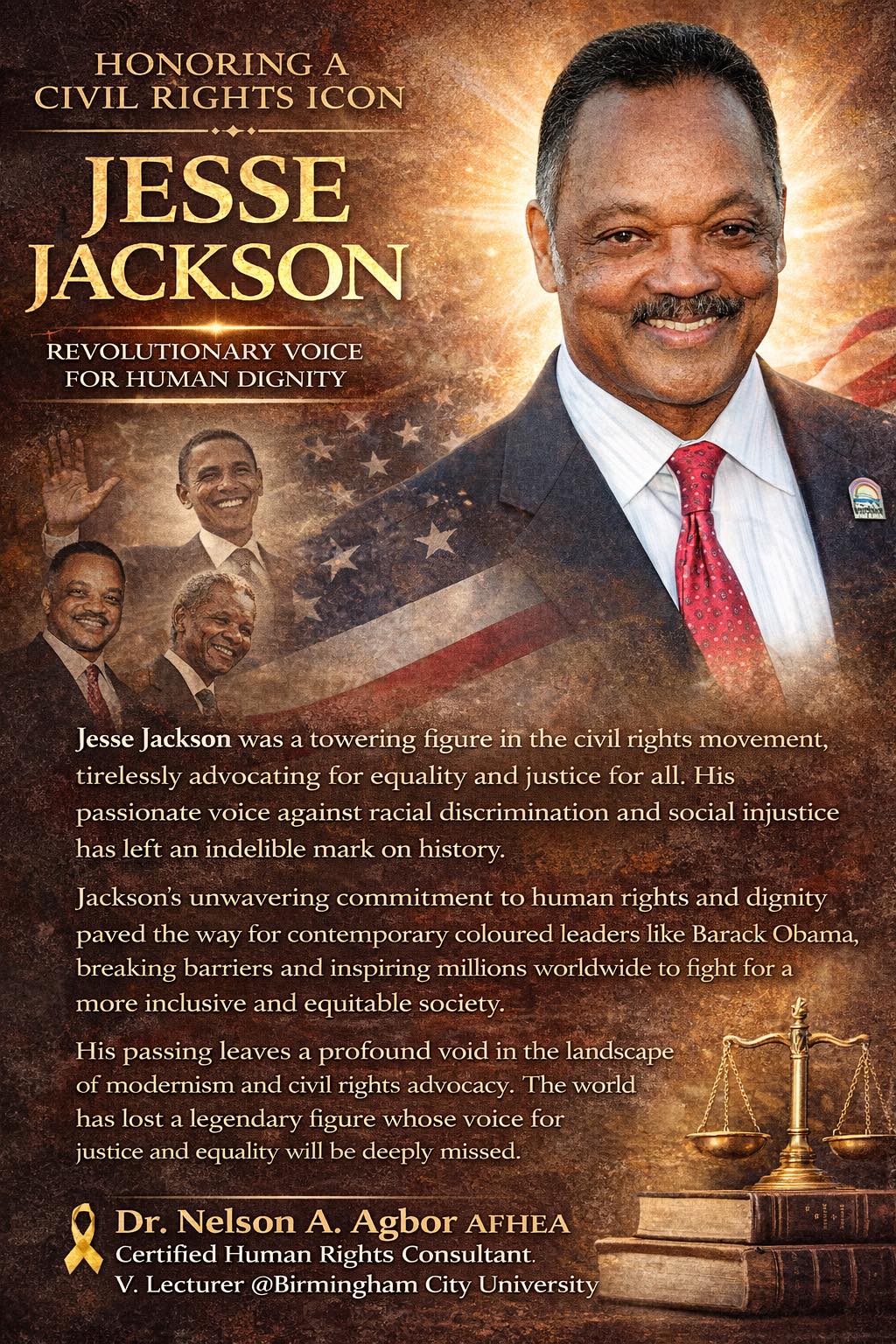
The life and work of Reverend Jesse L. Jackson stand as a defining chapter in the history of the American civil rights movement and the global struggle for human dignity. Emerging from the moral and political momentum of the 1960s, Jackson worked closely with Dr Martin Luther King Jr. He became a prominent advocate for nonviolent protest, economic justice, and political empowerment for African Americans. Through organisations such as Operation PUSH and the Rainbow Coalition, he broadened the scope of civil rights activism beyond desegregation to include economic equity, labour rights, and political representation, thereby reframing civil rights as an ongoing project of democratic inclusion.
Jackson’s influence extended beyond protest into institutional politics. His historic presidential campaigns in 1984 and 1988 challenged entrenched racial barriers in American political life, mobilised minority voters, and advanced a multiracial political coalition grounded in shared social and economic concerns. By bringing issues such as voting rights, educational access, and economic justice into the national political discourse, he helped reshape the Democratic Party and the broader political landscape. His campaigns demonstrated that leadership at the highest levels of government was not the preserve of one racial group but a democratic possibility open to all.
The symbolic and practical pathways Jackson helped carve proved instrumental for later generations of leaders, including figures such as Barack Obama. Jackson’s insistence on political participation, coalition-building, and moral accountability helped normalise the presence of Black leadership within national governance and international diplomacy. In this sense, his work not only expanded opportunities for African Americans but also redefined the moral vocabulary of leadership in a pluralistic society, emphasising dignity, representation, and justice as foundational democratic principles.
As Jackson leaves the stage, scholars and observers alike reflect on the profound void his absence will create in the spheres of civil rights advocacy, moral leadership, and global human rights discourse. His voice has long functioned as both conscience and catalyst, reminding societies of their unfinished commitments to equality and justice. The enduring challenge for contemporary movements will be to sustain the moral clarity, coalition politics, and commitment to human dignity that defined his legacy, ensuring that the struggle for civil rights continues not as memory but as a living, evolving pursuit.
Palestinian Centre for Human Rights
Center for Human Rights in Iran
Centre for Human Rights and Democracy in Africa
US Institute of Diplomacy and Human Rights
Dr Nelson A. Agbor AFHEA,
Certified Human Rights Consultant,
V. Lecturer @Birmingham City University.




