
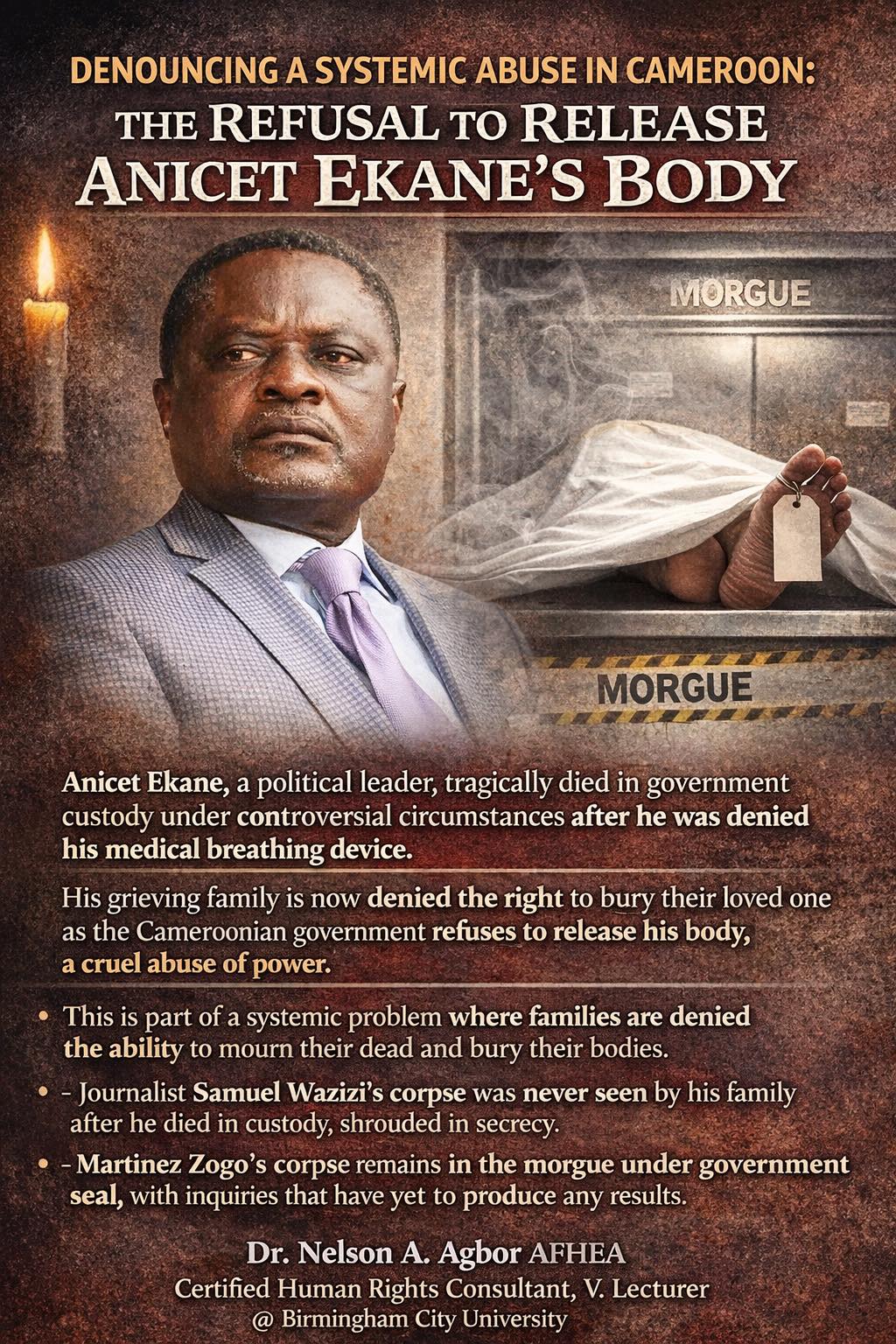
The withholding of Anicet Ekane’s body by Cameroonian authorities raises profound concerns about state accountability, human dignity, and the rule of law. The political leader died in government custody under controversial circumstances after being denied access to his prescribed medical breathing device. The continued refusal to release his remains to his family not only compounds their grief but also violates fundamental cultural, legal, and humanitarian norms surrounding burial and mourning.
From an academic and human rights point of view, the denial of a body to the next of kin represents a serious abuse. Across societies, the right of families to recover and bury their dead is recognised as an essential component of human dignity and transitional justice. When a state obstructs this process, it signals a troubling willingness to subordinate basic human rights to political expediency. Such actions undermine public trust in institutions and deepen perceptions of impunity.
This case is not isolated. The disappearance of journalist Samuel Wazizi’s remains following his death in custody remains one of the most disturbing examples of opacity in Cameroon’s detention system. His family never saw his body, nor were they given transparent documentation explaining the circumstances of his death. Similarly, the remains of investigative journalist Martinez Zogo remain under government seal in a morgue, while official inquiries have yet to produce conclusive or publicly credible results. These unresolved cases reinforce a pattern of secrecy surrounding deaths in state custody.
Taken together, these incidents suggest a systemic problem rather than a series of administrative irregularities. When detainees die under controversial conditions, and their bodies are withheld, sealed, or never returned, the result is an erosion of legal safeguards, due process, and democratic accountability. Such practices obstruct independent investigation, prevent forensic verification, and deny families closure while shielding authorities from scrutiny.
The Cameroonian government must recognise that transparency, respect for human dignity, and the rule of law are inseparable from political legitimacy. Releasing Anicet Ekane’s body to his family, providing full disclosure regarding the circumstances of his death, and ensuring credible investigations into the cases of Wazizi and Zogo would constitute essential steps toward restoring public confidence. Without such measures, these tragedies will continue to symbolise systemic injustice rather than isolated failures.
US Institute of Diplomacy and Human Rights
Centre for Human Rights and Democracy in Africa
Dr Nelson A. Agbor AFHEA,
Certified Human Rights Consultant
V. Lecturer @ Birmingham City University.




