
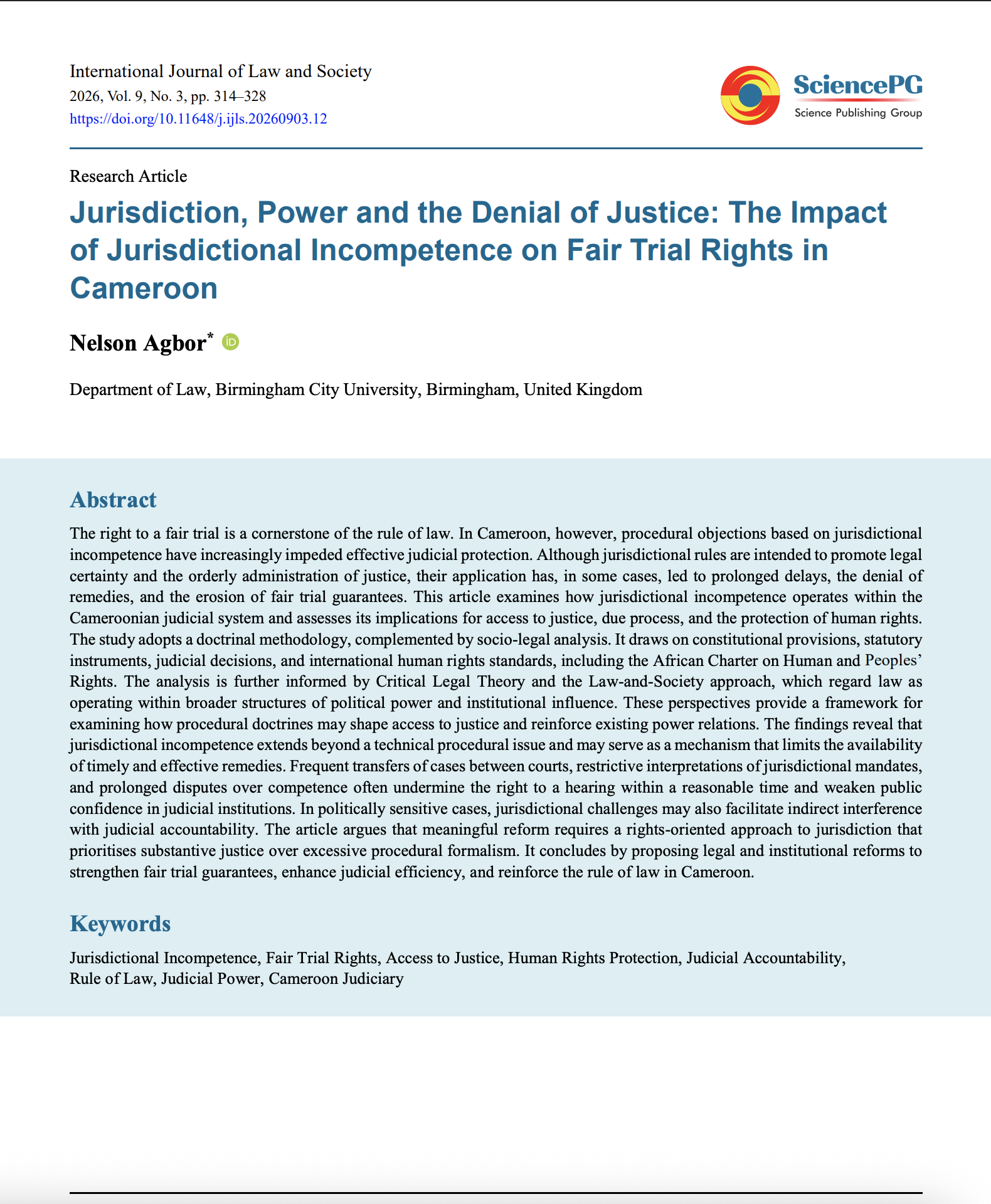
Nelson Agbor
International Journal of Law and Society, Volume 9, Issue 3, 2026
Pages 314–328 · Published 17 July 2026
DOI: 10.11648/j.ijls.20260903.12
This peer-reviewed article examines how jurisdictional incompetence operates within the Cameroonian judicial system and considers its consequences for fair trial rights, access to justice, judicial accountability and the rule of law.
It argues that jurisdiction should not be treated solely as a technical question concerning the authority of a court. Where jurisdictional objections result in repeated transfers, prolonged proceedings or the dismissal of claims without substantive adjudication, procedural law may itself become an obstacle to justice.
Read the full published article: https://www.sciencepg.com/article/10.11648/j.ijls.20260903.12
Publication overview
Jurisdiction determines whether a court has the legal authority to hear and decide a dispute. It is essential to the lawful administration of justice, the appropriate allocation of cases and the preservation of institutional order.
In Cameroon, however, disputes over jurisdictional competence may significantly delay proceedings and prevent courts from addressing the substance of legal claims. Litigants may encounter repeated transfers between ordinary courts, administrative courts, specialised tribunals and military jurisdictions, often at considerable financial and procedural cost.
The article examines this problem through a combination of doctrinal legal analysis and socio-legal inquiry. It considers constitutional provisions, legislation, procedural rules, judicial decisions and international human rights standards, including the African Charter on Human and Peoples’ Rights and the International Covenant on Civil and Political Rights.
The analysis is informed by Critical Legal Theory and Law-and-Society scholarship. These approaches challenge the assumption that legal doctrines operate independently of political and institutional power. Within this framework, decisions concerning jurisdiction are understood not merely as neutral procedural determinations, but as decisions that shape access to remedies, distribute judicial authority and determine the degree to which public power is subject to legal scrutiny.
Publication details
Author: Nelson Agbor
Journal: International Journal of Law and Society
Volume: 9
Issue: 3
Year: 2026
Pages: 314–328
Article type: Peer-reviewed research article
Access: Open access
DOI: 10.11648/j.ijls.20260903.12
The central legal problem
The article identifies a fundamental tension between procedural legality and substantive justice.
Jurisdictional rules serve legitimate purposes. Courts must act within the authority conferred upon them, and disputes should ordinarily be heard by the legally appropriate forum. Yet strict or excessively formalistic applications of these rules may frustrate the wider purpose of the judicial system: the timely and effective determination of rights.
Procedural delay
Jurisdictional objections can consume substantial judicial time before the merits of a dispute are considered. Cases may move repeatedly between judicial forums, while appeals concerning competence prolong proceedings further.
Such delays are particularly serious where the dispute concerns detention, political participation, property, employment or an alleged violation of fundamental rights. In these circumstances, an eventual remedy may arrive too late to provide meaningful protection.
Denial of effective remedies
A finding that a court lacks jurisdiction may require a litigant to commence proceedings again before another forum. This can increase costs, duplicate procedural work and create uncertainty about where a remedy can properly be pursued.
Where no alternative forum is clearly available, jurisdictional decisions may create a remedial vacuum in which a legal right exists in principle but cannot be effectively enforced.
Judicial power and institutional influence
The choice of judicial forum affects more than procedure. Different courts and tribunals may offer different levels of independence, procedural protection and appellate review.
In politically sensitive cases, jurisdictional allocation may therefore influence the quality of justice available and the extent to which executive or institutional power is exposed to judicial scrutiny.
Case law and institutional context
The article examines several areas in which jurisdictional disputes have had significant consequences for fair trial rights and access to justice.
Specialised criminal jurisdiction
Cases involving the Special Criminal Court demonstrate the tension between institutional specialisation and procedural protection. Although specialised jurisdiction may improve efficiency in complex financial prosecutions, transfers from ordinary courts can disrupt established proceedings and affect appeal rights.
The article considers the case of Achille Benoît Zogo Andela v Cameroon as an example of how the reallocation of jurisdiction may raise questions concerning competence, impartiality and the right to a fair hearing.
Military tribunals and civilian defendants
The prosecution of civilians before military tribunals raises particularly serious concerns. The article examines proceedings involving Julius Sisiku Ayuk Tabe and other Anglophone separatist leaders, as well as Maurice Kamto and supporters of the Cameroon Renaissance Movement.
These cases illustrate how the choice of forum can affect judicial independence, defence rights and public perceptions of political neutrality. They also raise the wider question of whether military jurisdiction over civilians can be reconciled with international fair trial standards.
Administrative and constitutional disputes
Administrative cases reveal how restrictive interpretations of jurisdiction may limit scrutiny of state action. Where courts decline to consider claims involving governmental authority and no effective alternative forum is available, jurisdictional restraint may weaken accountability.
The article argues that this concern is particularly significant in constitutional, electoral and administrative disputes, where procedural rules determine who may challenge public decisions and whether those challenges receive substantive judicial consideration.
Land and collective rights
The Bakweri Land Claims Committee v Cameroon proceedings demonstrate how jurisdictional and admissibility rules can affect collective rights and historical claims.
In land disputes, procedural delay may have irreversible consequences. Property may be transferred, developed or occupied while litigation remains unresolved, reducing the practical value of any eventual remedy.
Jurisdictional competence should function as a gateway to justice, rather than as a mechanism through which substantive adjudication is indefinitely deferred.
Human rights implications
The article identifies several interconnected consequences of jurisdictional incompetence.
The first is the potential violation of the right to a hearing within a reasonable time. International and regional human rights law requires judicial proceedings to be conducted without undue delay. Repeated disputes over competence may therefore become human rights violations in their own right.
The second is restricted access to justice. Complex procedural requirements disproportionately affect vulnerable litigants, including detainees, political activists, minority communities, rural populations and those without the resources to sustain prolonged litigation.
The third is the erosion of due process. Transfers between forums can disrupt legal preparation, create inconsistent procedural requirements and expose litigants to courts or tribunals offering different levels of protection.
The fourth is weakened public confidence. When courts appear to prioritise technical objections over the determination of substantive rights, the judiciary may be perceived as inaccessible, inefficient or insufficiently independent.
Reforming jurisdictional practice
The article proposes a rights-centred approach to jurisdictional reform.
Clarifying judicial mandates
Legislation should define more clearly the respective authority of ordinary courts, administrative courts and specialised tribunals. Reducing overlaps would limit uncertainty, strategic objections and unnecessary forum disputes.
Transferring rather than dismissing cases
Where proceedings have been commenced in the wrong forum, courts should ordinarily transfer the matter directly to the competent court rather than requiring the litigant to begin again.
Evidence, procedural steps and filing dates should be preserved wherever possible.
Limiting delays
Jurisdictional objections should be resolved within defined time limits. Courts should avoid allowing procedural disputes to suspend substantive justice indefinitely.
Restricting military jurisdiction
The jurisdiction of military tribunals over civilians should be reconsidered and restricted in accordance with international human rights standards.
Adopting a rights-oriented judicial approach
Courts should interpret jurisdictional rules in light of constitutional values, access to justice and the right to an effective remedy.
Procedural consequences should be proportionate to the defect identified. Minor errors should not result in the complete denial of judicial protection where a less restrictive solution is available.
Strengthening transparency and accountability
Courts should provide clear and reasoned explanations when declining jurisdiction. Decisions should identify the competent alternative forum and explain how the litigant may continue the claim.
Judicial authorities should also collect data on jurisdictional dismissals, case transfers and resulting delays so that systemic problems can be identified and addressed.
Wider significance
The article demonstrates that jurisdiction is inseparable from questions of power, accountability and institutional legitimacy.
The authority to decide which court may hear a dispute also determines which claims receive judicial attention, which institutions are subjected to scrutiny and which litigants obtain an effective remedy. Jurisdictional rules therefore influence the practical distribution of legal protection within society.
This is particularly important in politically sensitive cases. The use of specialised or military forums, restrictive standing requirements and narrow interpretations of judicial competence may preserve procedural legality while limiting substantive accountability.
The article does not argue that jurisdictional limits should be abandoned. Courts must continue to respect the boundaries of their lawful authority. It instead argues that jurisdictional rules should be designed and interpreted in a manner that supports, rather than frustrates, the purposes of justice.
A rights-centred jurisdictional framework would preserve legal certainty while reducing delay, procedural exclusion and remedial failure. Such reform is necessary not only for the protection of individual litigants, but also for public confidence in the judiciary, democratic governance and the rule of law in Cameroon.
Recommended citation
Agbor, N. (2026). “Jurisdiction, Power and the Denial of Justice: The Impact of Jurisdictional Incompetence on Fair Trial Rights in Cameroon.” International Journal of Law and Society, 9(3), 314–328. https://doi.org/10.11648/j.ijls.20260903.12
Button: Access the complete journal article
Link: https://www.sciencepg.com/article/10.11648/j.ijls.20260903.12




