
Nelson Agbor
International Journal of Law and Society, Volume 9, Issue 2, 2026
Pages 289–303 · Published 25 June 2026
DOI: 10.11648/j.ijls.20260902.25
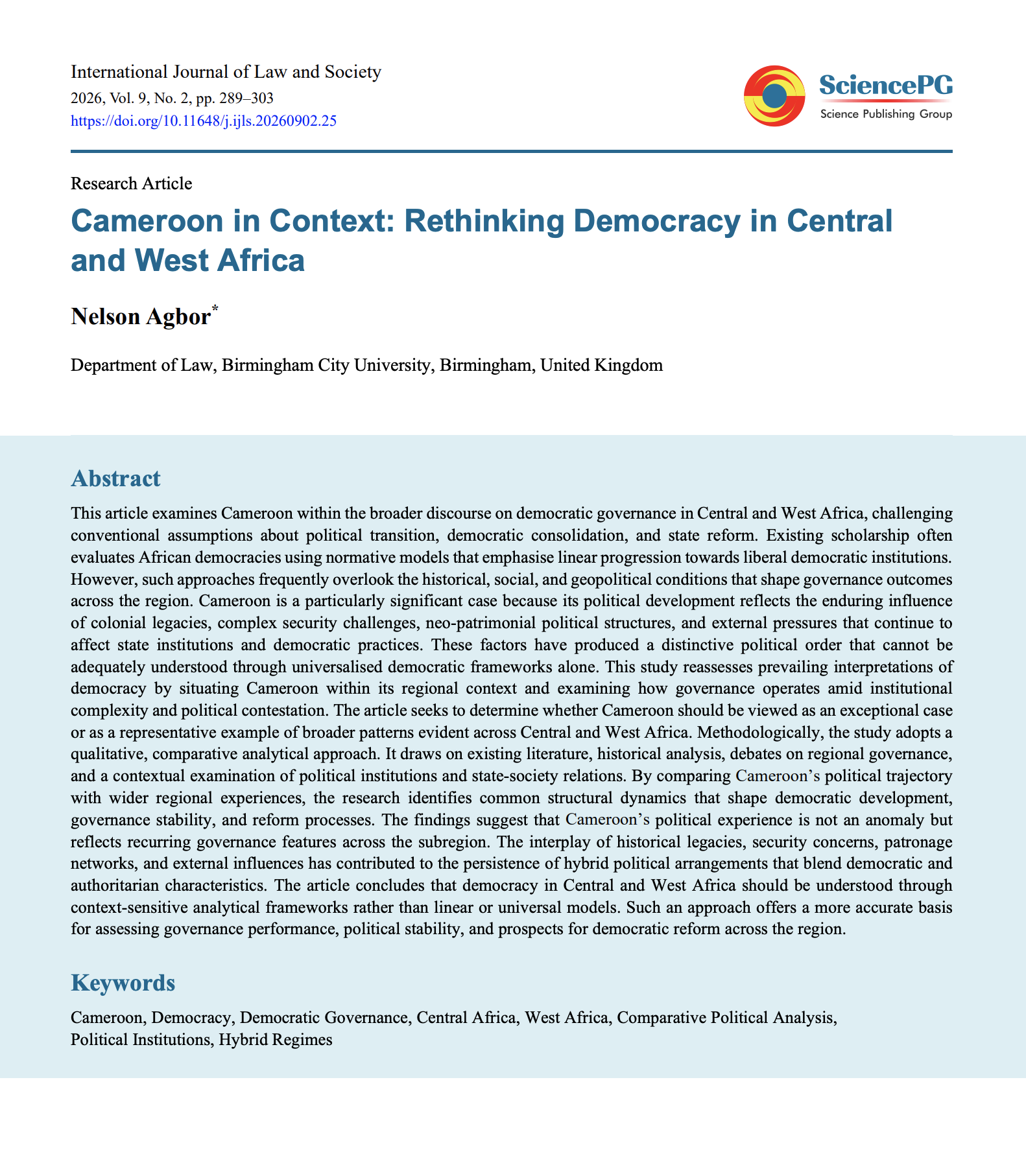
This peer-reviewed article examines Cameroon as a lens through which to reconsider the changing character of democracy across Central and West Africa. It challenges the assumption that political development in the region can be measured adequately against a linear transition from authoritarian government towards consolidated liberal democracy.
Read the full published article
Publication overview
Formal democratic institutions are now well established across much of Central and West Africa. Elections are regularly conducted, opposition parties are legally recognised, constitutional frameworks remain in force, and governments continue to invoke the language of democratic legitimacy.
These institutional forms, however, frequently coexist with entrenched executive authority, restricted civic space, patronage networks, constitutional manipulation and security-based limitations on political participation. The resulting political systems cannot be described adequately through a simple distinction between democracy and authoritarianism.
Using Cameroon as its principal case study, the article considers whether these developments represent democratic decline, authoritarian adaptation or a broader transformation towards hybrid forms of governance. Cameroon is treated not as an isolated exception, but as a representative case through which recurring regional patterns may be understood.
The analysis draws upon historical institutional research, comparative political analysis and an examination of the relationship between formal institutions and informal structures of power. Particular attention is given to colonial legacies, prolonged incumbency, the Anglophone conflict, regional insecurity, political exclusion, digital repression and the continuing tension between state stability and democratic legitimacy.
Publication details
Author: Nelson Agbor
Journal: International Journal of Law and Society
Volume: 9
Issue: 2
Year: 2026
Pages: 289–303
Article type: Peer-reviewed research article
Access: Open access
DOI: 10.11648/j.ijls.20260902.25
Central argument
The article advances three related propositions.
Cameroon is not an anomaly
Cameroon’s combination of multiparty elections, centralised executive power, restricted political competition and security-driven governance reflects wider patterns found across Central and West Africa. Its political trajectory therefore offers broader comparative value.
Democratic institutions may enable authoritarian adaptation
Elections, constitutions and legal institutions do not necessarily prevent the consolidation of executive authority. They may also be selectively managed or reinterpreted to preserve political control while maintaining the appearance of democratic legitimacy.
Democratic change is multidirectional
Political systems may display democratic resilience, authoritarian consolidation and institutional transformation simultaneously. Civic activism and electoral participation can continue even as civil liberties contract and state control becomes more sophisticated.
Wider significance
The article argues that democracy in Central and West Africa should be assessed through context-sensitive frameworks rather than universalised models of political transition. Historical experience, institutional capacity, security pressures, regional inequalities and informal relations of power all influence how democratic structures operate in practice.
This approach does not dismiss elections, constitutional government or civic participation as insignificant. Instead, it asks how these institutions function within political systems where democratic procedures coexist with executive dominance, legalistic repression and contested state legitimacy.
Cameroon consequently provides an important case for scholars, legal practitioners and policy researchers examining democratic backsliding, constitutional governance, political legitimacy and human rights protection. Its experience illustrates that democracy in the region may be neither simply consolidating nor collapsing. It is being renegotiated through evolving relationships between law, security, political authority and citizen agency.
Recommended citation
Agbor, N. (2026). “Cameroon in Context: Rethinking Democracy in Central and West Africa.” International Journal of Law and Society, 9(2), 289–303. https://doi.org/10.11648/j.ijls.20260902.25
Button: Access the complete journal article
Link: https://www.sciencepublishinggroup.com/article/10.11648/j.ijls.20260902.25




