
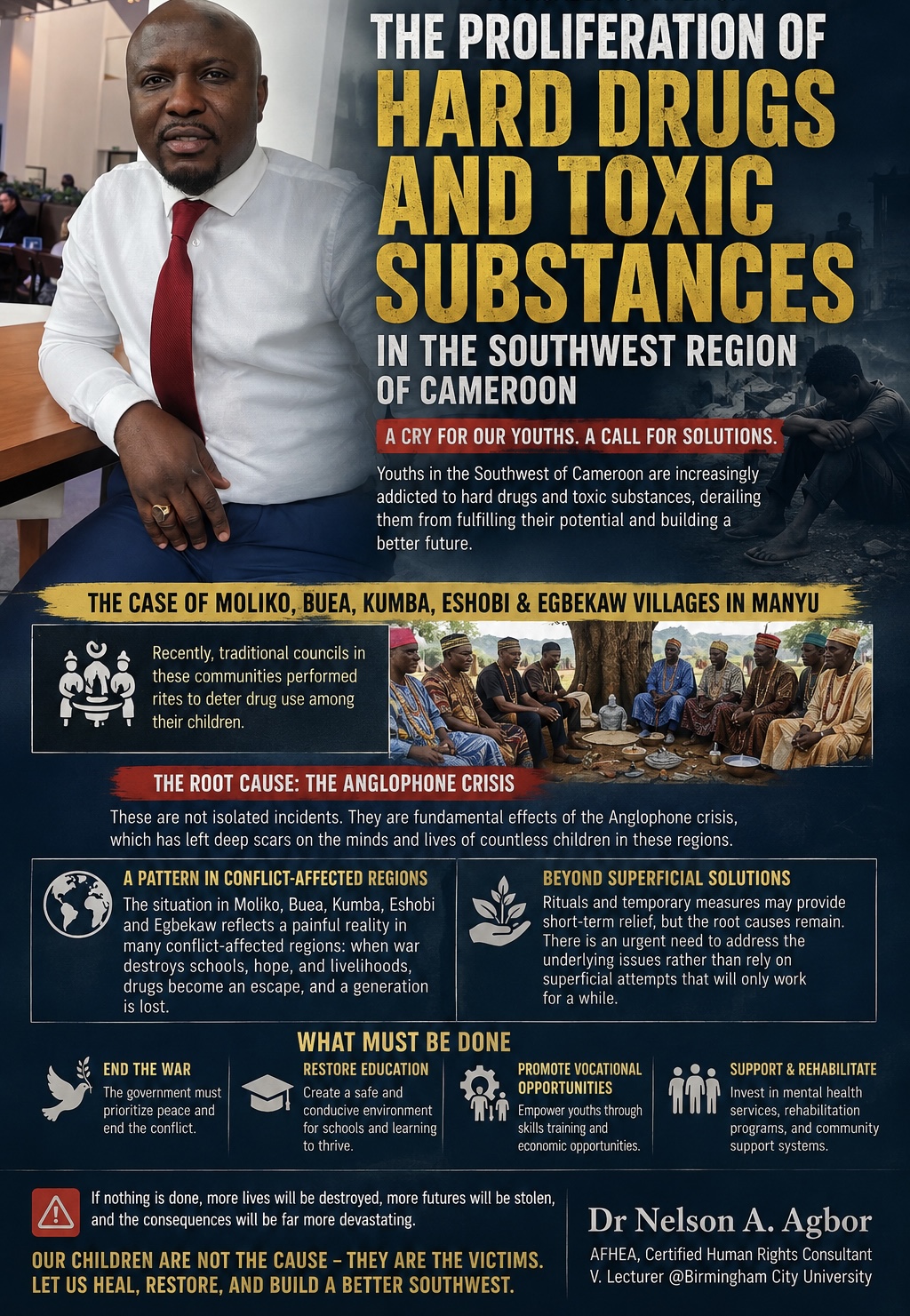
The growing use of hard drugs and toxic substances among young people in the Southwest Region of Cameroon has become a serious social, public health, and security concern. Across several communities, particularly in urban and semi-urban centres, the consumption of narcotics, pharmaceutical drugs, alcohol mixtures, and other harmful substances has reached alarming levels. Many young people who should be engaged in education, vocational training, entrepreneurship, and productive economic activities are increasingly trapped in cycles of addiction and dependency. This phenomenon has generated widespread concern among families, community leaders, religious institutions, and policymakers, who recognise that substance abuse is steadily eroding the social fabric of affected communities and jeopardising the future of an entire generation.
The problem is particularly evident in localities such as Moliko in Buea, Kumba, and the villages of Eshobi and Egbekaw in Manyu Division. Reports from these communities indicate that drug abuse among adolescents and young adults has become increasingly visible, manifesting as antisocial behaviour, school drop-out, criminality, and declining community cohesion. The prevalence of substance abuse has become so troubling that traditional authorities and community elders have felt compelled to intervene directly. In some instances, traditional councils have organised rites and customary ceremonies to discourage youth drug use and to invoke communal values that emphasise discipline, responsibility, and respect for societal norms. These actions demonstrate the extent of community concern about the deteriorating moral and social conditions affecting young people.
While such traditional interventions may carry symbolic significance and reinforce communal disapproval of drug abuse, they are unlikely to provide a lasting solution if the underlying causes remain unaddressed. Drug addiction is rarely an isolated phenomenon; rather, it often stems from broader social, economic, and psychological pressures. In the Southwest region of Cameroon, substance abuse cannot be adequately understood without examining the wider context of prolonged conflict, displacement, trauma, and economic disruption that have characterised the region over the past several years. Consequently, any sustainable response must move beyond cultural deterrence and address the structural conditions that continue to fuel youth vulnerability.
The ongoing Anglophone Crisis is one of the most significant drivers of the current drug abuse epidemic in the region. Since the escalation of armed conflict in 2016, many communities have experienced persistent insecurity, forced displacement, infrastructure destruction, and disruptions to normal social life. Thousands of children and adolescents have grown up in environments marked by violence, uncertainty, and fear. Exposure to traumatic events, including the loss of family members, displacement from homes, and disruption of education, has left deep psychological scars on many young people. In such circumstances, drugs and toxic substances often become coping mechanisms through which vulnerable individuals seek temporary relief from emotional distress and hopelessness.
The educational consequences of the conflict have been particularly devastating. Numerous schools have been closed for extended periods, and many students have been unable to engage in regular academic activities due to insecurity. Education serves not only as a means of acquiring knowledge but also as a critical protective factor against social deviance and substance abuse. When young people are disconnected from schools, they lose access to structured environments, mentorship opportunities, and positive peer interactions. The resulting idleness creates fertile ground for drug experimentation and addiction. In communities where educational systems have been severely weakened, the absence of meaningful alternatives has significantly increased the risk of youth involvement in substance abuse.
Equally important academic activities are due to the economic consequences of the crisis. The conflict has disrupted agriculture, commerce, transport, and other livelihood activities that previously sustained many families. Rising unemployment and poverty have left numerous young people without viable prospects for personal advancement. For many young people facing economic despair, drug use becomes both an escape from daily hardships and a reflection of diminished hope for the future. In addition, criminal networks involved in the distribution of narcotics often exploit such vulnerabilities, targeting unemployed young people who may become consumers, distributors, or facilitators within illicit drug markets.
The experiences of the Southwest of Cameroon reflect broader patterns observed in conflict-affected regions worldwide. Research on post-conflict societies consistently shows strong correlations between armed conflict, psychological trauma, social fragmentation, and increased substance abuse. Countries emerging from prolonged violence frequently see elevated rates of drug addiction among young people, driven by disrupted social institutions, weakened family structures, and limited access to mental health services. The situation in communities such as Moliko, Kumba, Eshobi, and Egbekaw therefore represents not merely a local challenge but a manifestation of broader dynamics commonly associated with conflict and social instability.
Addressing the drug crisis requires comprehensive, evidence-based interventions. First, there is an urgent need to strengthen mental health and psychosocial support services for children and adolescents affected by conflict. Many young people are struggling with untreated trauma, anxiety, depression, and other psychological conditions that contribute to substance abuse. Community counselling centres, rehabilitation programmes, school-based mental health initiatives, and youth mentorship schemes should be expanded to support vulnerable populations. Simultaneously, awareness campaigns involving parents, teachers, religious leaders, and traditional authorities can foster greater understanding of addiction as both a social and a health issue.
More fundamentally, the government must intensify efforts to address the root causes of instability in the Anglophone regions. Lasting peace remains the most important prerequisite for reversing current trends. The continuation of armed conflict perpetuates the conditions that facilitate drug abuse among young people. Ending the war, restoring security, rebuilding educational institutions, and creating an environment conducive to economic development are essential to any sustainable strategy. Furthermore, investments in vocational training, entrepreneurship programmes, sports initiatives, and youth employment schemes can provide constructive alternatives that empower young people to contribute meaningfully to society.
In conclusion, the proliferation of hard drugs and toxic substances among young people in the Southwest of Cameroon is a complex crisis rooted in the broader realities of conflict, displacement, trauma, and socio-economic deprivation. While recent interventions by traditional councils in Moliko, Kumba, Eshobi, and Egbekaw demonstrate commendable community concern, such measures alone cannot resolve a problem driven by deep structural factors. Sustainable solutions require a coordinated approach that prioritises peacebuilding, educational recovery, economic revitalisation, mental health support, and youth empowerment. Failure to address these fundamental issues risks exposing the region to even greater social, economic, and security consequences in the years ahead, with potentially irreversible effects on the future of an entire generation.
Dr Nelson A. Agbor AFHEA
Certified Human Rights Consultant
V. Lecturer @Birmingham City University.




