
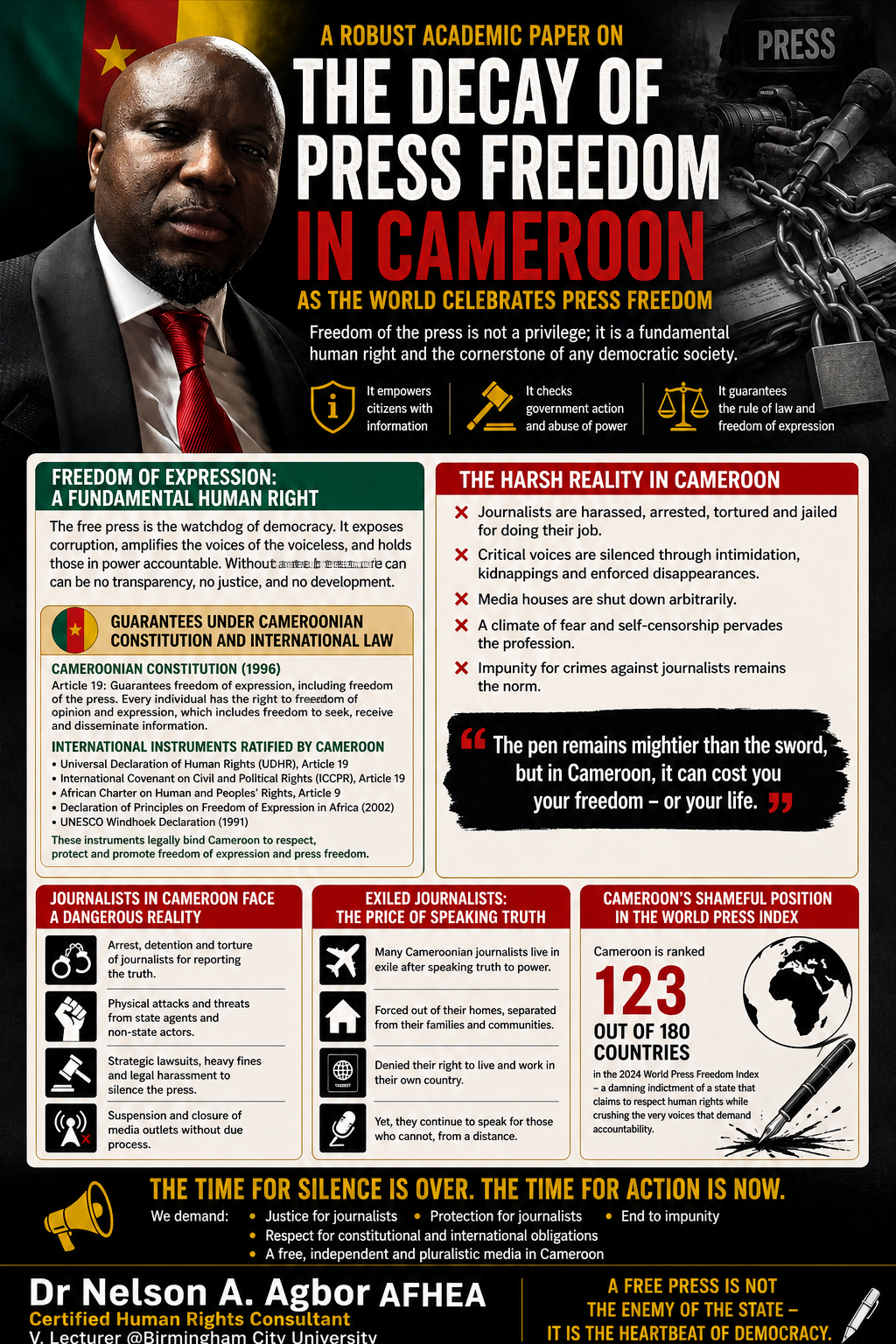
The global observance of World Press Freedom Day on Sunday, 3 May 2026, offers an important opportunity to interrogate the state of media freedoms across jurisdictions. While the day celebrates journalism’s foundational role in democratic societies, it also exposes stark disparities between formal legal guarantees and lived realities. In Cameroon, this contrast is particularly acute: constitutional commitments to freedom of expression coexist with systemic repression, intimidation, and, in extreme cases, the lethal targeting of journalists.
Freedom of the press occupies a central place in the architecture of human rights. It is both a standalone liberty and an enabling right that facilitates the realisation of other rights, including political participation, access to information, and accountability. The theoretical grounding of press freedom lies in liberal constitutionalism, in which the press functions as a watchdog against arbitrary power, ensuring transparency and fostering deliberative democracy.
Within the Cameroonian legal framework, freedom of expression is explicitly guaranteed by the 1996 Constitution, which accords the Preamble full constitutional value. The Preamble affirms that “freedom of communication, of expression, of the press… shall be guaranteed under the conditions fixed by law.” This formulation ostensibly aligns Cameroon with global constitutional standards, suggesting a commitment to safeguarding journalistic independence and pluralism.
Beyond domestic law, Cameroon is bound by a range of international legal instruments that reinforce these guarantees. These include the United Nations’ International Covenant on Civil and Political Rights, particularly Article 19, which protects the right to freedom of expression, and the African Union’s African Charter on Human and Peoples’ Rights, which enshrines similar protections. Additionally, soft-law instruments, such as the Declaration of Principles on Freedom of Expression and Access to Information in Africa, further elaborate on these norms.
In principle, these legal commitments provide a robust framework for protecting journalists and the media. They impose both negative obligations, requiring the state to refrain from interference, and positive obligations, mandating the creation of an enabling environment for free and independent journalism. However, the effectiveness of these guarantees depends on institutional enforcement, political will, and respect for the rule of law.
In practice, Cameroon diverges troublingly from these standards. The media landscape is characterised by restrictive legislation, arbitrary arrests, and the use of security laws to criminalise journalism. The judiciary, often perceived as lacking independence, has been instrumentalised to legitimise these constraints, thereby undermining constitutional protections.
The killing of journalists in opaque and precarious circumstances underscores the severity of the situation. The case of Samuel Wazizi, who died in military custody in 2019 after being arrested in the conflict-ridden Anglophone regions, remains emblematic of impunity. Authorities initially concealed his death, and subsequent investigations failed to deliver credible accountability, raising serious concerns about enforced disappearance and extrajudicial killing.
Similarly, the 2023 assassination of Martinez Zogo sent shockwaves through the media community. Zogo, known for his investigative reporting on corruption, was abducted, tortured, and killed in a manner that suggested a deliberate attempt to silence dissent. Although arrests were eventually made, the broader structural conditions that enable such violence persist.
These cases are not isolated incidents but part of a broader pattern of hostility towards critical journalism. The climate of fear has forced many journalists into exile, effectively narrowing the domestic space for independent reporting. Exile, while providing physical safety, exacts high professional and psychological costs, including disconnection from local sources and audiences.
Among those compelled to flee are prominent figures, including Mimi Mefo, whose reporting on the Anglophone crisis led to harassment and threats; Nfor Hanson, who faced legal persecution; J P Remy Ngono, known for his outspoken criticism of government officials; and Paul Chouta, who survived violent attacks before leaving. Their experiences underscore the systemic risks of investigative journalism in Cameroon.
The international community has taken note of these developments. Organisations such as Reporters Without Borders consistently rank Cameroon low in the World Press Freedom Index. The country’s position reflects not only incidents of violence but also structural constraints, including regulatory overreach, economic pressures, and limited media pluralism.
This low ranking has reputational and practical implications. It signals to investors, development partners, and diplomatic actors that governance deficits persist, particularly in transparency and accountability. Moreover, it undermines Cameroon’s ability to participate credibly in international human rights discourse.
The persistence of these challenges raises fundamental questions about the gap between law and practice. While constitutional and international guarantees provide a normative baseline, their realisation requires effective institutions, such as an independent judiciary, a professional security sector, and regulatory bodies insulated from political interference. Without them, legal provisions risk becoming purely symbolic.
Addressing the decline in press freedom in Cameroon requires a multi-layered approach. Domestically, there must be a commitment to legal reform, including the decriminalisation of press offences and the repeal of vague security laws that are used to target journalists. Institutional reforms should prioritise judicial independence and protect media actors from arbitrary detention and violence.
At the international level, sustained pressure from regional and global bodies is essential. Mechanisms within the African Commission on Human and Peoples’ Rights and the United Nations human rights system should be utilised to hold Cameroon to account. This includes periodic reviews, special rapporteur interventions, and, where necessary, targeted sanctions.
In conclusion, the global celebration of press freedom serves as a stark reminder of the unfinished work in contexts such as Cameroon. The dissonance between formal guarantees and lived realities underscores the fragility of media freedoms in the absence of genuine political commitment. Ensuring the safety and independence of journalists is not merely a sectoral concern but a prerequisite for the rule of law, democratic governance, and the protection of human dignity.
Dr Nelson A. Agbor AFHEA
Certified Human Rights Consultant
V. Lecturer @Birmingham City University.




