
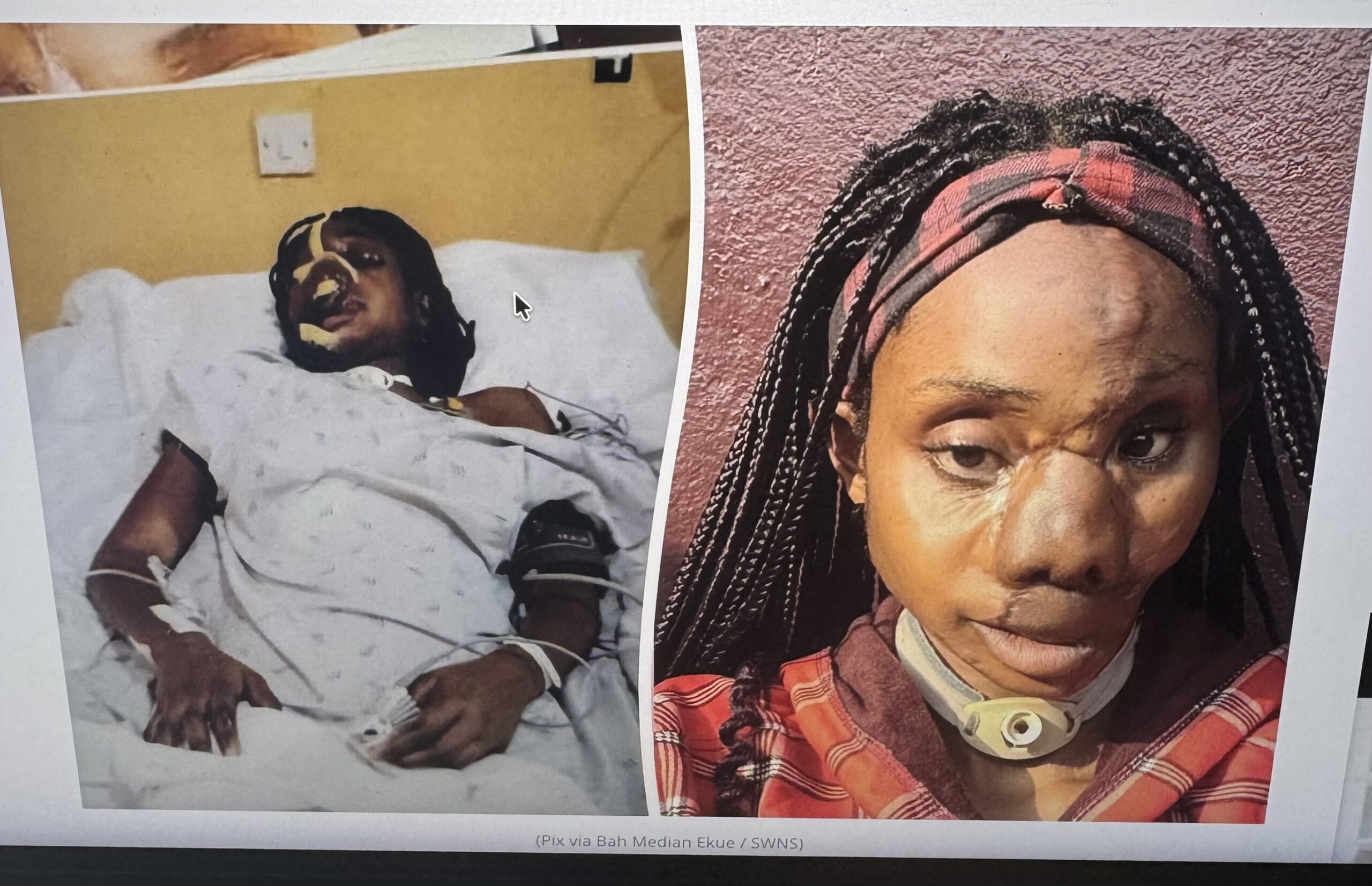
The protracted Anglophone Crisis in Cameroon has created a dense landscape of human suffering, institutional breakdown, and intergenerational trauma. Emerging in 2016 from grievances rooted in legal, educational, and linguistic marginalisation, the conflict has evolved into a violent confrontation between state forces and separatist groups. While much scholarly attention has focused on its political economy and security dynamics, insufficient analytical weight has been given to its enduring scars on children, arguably the most vulnerable demographic. The case of Bah Median Ekue, a 15-year-old girl gravely injured in 2018, offers a stark and deeply unsettling lens through which to examine these impacts.
Median’s ordeal encapsulates the indiscriminate brutality that has characterised several military operations in Anglophone regions. In 2018, amid heightened tension, she was reportedly locked inside a building by military personnel and left to die. The act itself reflects not merely operational excess but a profound erosion of civilian protection norms under international humanitarian law. Her survival, though remarkable, has not led to recovery; rather, it has inaugurated a prolonged period of physical and psychological suffering that continues to define her life.suffering that continues to define her existence.
The medical consequences of Median’s injuries are severe and ongoing. She requires complex reconstructive procedures, specifically plastic surgery, estimated at approximately 65,000 USD to restore basic functional and aesthetic aspects of her body. This figure, while substantial for private individuals or civil society organisations, is comparatively negligible within the fiscal framework of a sovereign state. The inability or unwillingness of public institutions to mobilise such resources raises serious questions about state priorities and distributive justice in post-conflict care.
Beyond the physical trauma, the psychosocial implications for Median are profound. Children exposed to extreme violence often develop long-term symptoms, including post-traumatic stress disorder (PTSD), social withdrawal, and disrupted identity formation. Median’s case is emblematic of a broader cohort of conflict-affected minors whose developmental trajectories have been irrevocably altered. The absence of structured rehabilitation mechanisms exacerbates these outcomes, entrenching cycles of vulnerability and marginalisation.
The Cameroonian government’s response, or lack thereof, underscores a troubling pattern of institutional negligence. In conflict settings, state legitimacy is often reinforced by visible commitments to victim support and reconstruction. However, the apparent disregard for cases such as Median’s undermines any claim to good-faith engagement with affected populations. Notably, the cost of her surgery is widely perceived as less than discretionary expenditures, such as fuel allowances allocated to a single government minister, thereby intensifying perceptions of inequity and moral failure.
From a governance perspective, this neglect signals a disconnect between macro-level policy rhetoric and micro-level humanitarian realities. While official narratives frequently emphasise national unity and stability, victims’ lived experiences, such as those of Median, reveal a deficit in accountability and responsiveness. This gap not only weakens domestic trust but also attracts critical scrutiny from international human rights observers.
In contrast to state inaction, civil society actors have demonstrated notable resilience and commitment. The Ayah Foundation, based in Buea, has emerged as a critical support structure for victims of the crisis. Through limited resources, the organisation has provided care, advocacy, and visibility for individuals like Median. Its interventions illustrate the indispensable role of grassroots organisations in conflict mitigation and humanitarian response, particularly in contexts where formal institutions are deficient.
Equally significant is the role of digital advocacy in amplifying Median’s plight. Social media has served as a parallel public sphere, enabling narratives that might otherwise be suppressed to gain traction. The renewed attention to Median’s case can be attributed in part to the efforts of General Valsero, whose platform has mobilised public awareness and sympathy. This underscores the evolving dynamics of information dissemination and the capacity of non-state actors to influence humanitarian outcomes.
The convergence of civil society action and digital mobilisation offers a viable pathway for immediate intervention, specifically, the fundraising needed for Median’s surgery. Crowdsourced financing, while not a substitute for state responsibility, provides a pragmatic means of urgent relief. A coordinated effort involving diaspora communities, local stakeholders, and international donors could feasibly bridge the financial gap and facilitate her medical treatment.
However, focusing solely on individual cases risks obscuring the structural dimensions of the crisis. Median’s suffering is not an isolated case but part of a systemic pattern affecting thousands of children across Anglophone regions. Addressing these broader dynamics requires a comprehensive cessation of hostilities, together with transitional justice mechanisms that prioritise victim restitution and institutional reform.
Ending the Anglophone Crisis is therefore not merely a political imperative but a humanitarian necessity. Sustainable peace would enable the reallocation of resources to reconstruction, healthcare, and psychosocial support for affected populations. Moreover, demonstrable efforts to assist victims such as Median would signal a meaningful shift in state posture from coercion to care, thereby rebuilding public trust.
In conclusion, the case of Bah Median Ekue crystallises the human cost of protracted conflict and the ethical obligations it imposes on both the state and society. Her continued suffering since 2018 is a testament to systemic neglect, yet interventions by organisations such as the Ayah Foundation and advocates such as General Valsero offer a counter-narrative of hope and agency. We need a decisive, collective response: immediate fundraising for her surgery and a long-term commitment to conflict resolution. Without such action, the scars borne by Median and countless others will persist as enduring indictments of institutional failure.
Dr Nelson A. Agbor AFHEA
Certified Human Rights Consultant
V. Lecturer @Birmingham City University.




