
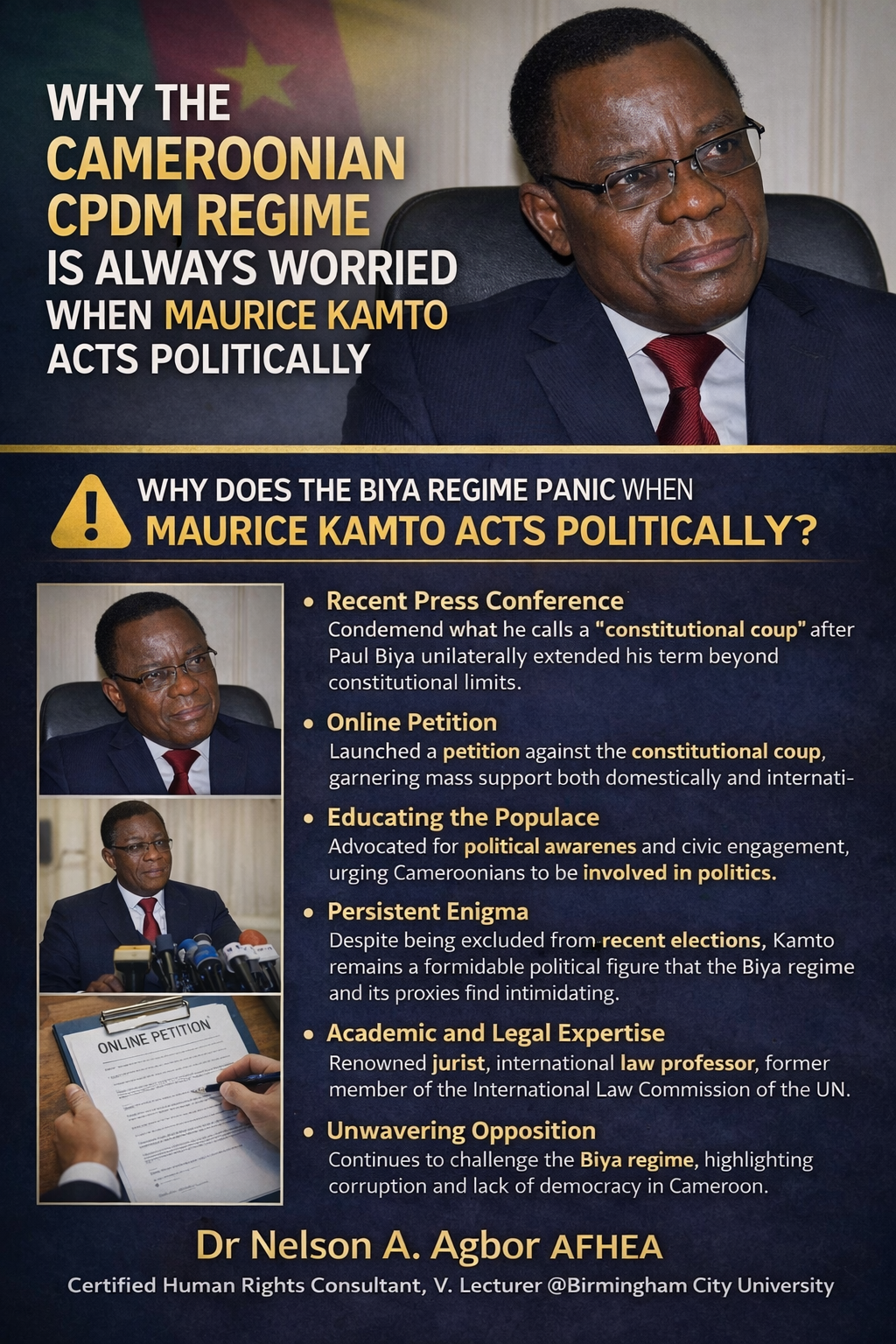
Contemporary political dynamics in Cameroon reveal a recurrent pattern: the ruling Cameroon People’s Democratic Movement (CPDM) appears persistently reactive, often entering what may be analytically described as “defensive panic mode” whenever Maurice Kamto undertakes a significant political act. This paper argues that such reactions are neither incidental nor purely rhetorical; rather, they are rooted in Kamto’s unique profile as a legal intellectual, his sustained capacity for political mobilisation, and the structural vulnerabilities of the regime led by Paul Biya. The most recent illustration is Kamto’s press conference and the launch of an online petition denouncing what he terms a “constitutional and institutional coup,” following constitutional amendments widely criticised by opposition actors.
The immediate context of Kamto’s latest intervention is critical. In early April 2026, Cameroon’s parliament adopted constitutional revisions reintroducing the office of vice president, a move opposition figures interpreted as facilitating dynastic succession within the ruling elite. In response, Kamto launched a public petition challenging the legitimacy and intent of these reforms, framing them as an erosion of constitutional order. This initiative is not merely symbolic; it mobilises digital participation and re-politicises a population often characterised by political fatigue. The regime’s visible discomfort stems from the participatory and discursive threat posed by such actions.
Historically, Kamto’s political trajectory has been defined by sustained confrontation with entrenched power. A former government minister turned opposition leader, he has drawn on both institutional knowledge and grassroots mobilisation. His challenge to the 2018 presidential election results and his subsequent arrest in 2019 exemplify his willingness to contest the regime’s legitimacy. These episodes contributed to his transformation into a symbolic figure of resistance, capable of galvanising segments of the population that might otherwise remain disengaged.
A key dimension of Kamto’s perceived threat is his deliberate pedagogical approach to politics. Unlike many opposition figures who rely primarily on populist rhetoric, Kamto emphasises civic education, encouraging citizens to understand constitutional processes, electoral systems, and their rights within the state. This intellectualisation of political engagement disrupts the CPDM’s long-standing reliance on political apathy and controlled participation. By reframing politics as a domain requiring informed citizen involvement, Kamto alters the epistemic terrain on which the regime operates.
Kamto’s resilience further intensifies the regime’s anxiety despite institutional exclusion. Notably, Cameroon’s electoral authorities barred him from the 2025 presidential election, a decision upheld by the Constitutional Council. While such exclusion might neutralise conventional political actors, Kamto has paradoxically maintained, and arguably expanded, his influence. This persistence renders him a “political enigma”: a figure whose power is not contingent on formal electoral participation but on discursive and symbolic capital.rsive and symbolic capital.
Moreover, Kamto’s academic and professional credentials enhance his legitimacy both domestically and internationally. As a professor of law, a barrister, and a former member of the United Nations International Law Commission, he embodies a rare combination of intellectual authority and practical expertise. His role in resolving the Bakassi Peninsula dispute between Cameroon and Nigeria further underscores his diplomatic competence. This profile contrasts sharply with the ageing leadership of the CPDM, thereby accentuating generational and epistemic divides.
From the regime’s perspective, Kamto’s international stature poses an additional risk: the potential internationalisation of domestic political disputes. His familiarity with international legal norms and institutions enables him to frame Cameroon’s internal governance issues within broader discourses of constitutionalism, human rights, and democratic accountability. This capacity risks attracting external scrutiny and undermining the regime’s narrative sovereignty.
The concept of “panic mode” can thus be analytically linked to regime insecurity. Cameroon’s political system, characterised by prolonged incumbency, has been in power since 1982 and has relied on stability narratives and controlled succession mechanisms. Kamto’s interventions, particularly those challenging constitutional reforms, destabilise these narratives by exposing underlying tensions, including fears of dynastic succession and institutional capture.
Additionally, Kamto’s strategic use of modern communication tools, such as online petitions, marks an evolution in opposition tactics. By bypassing traditional state-controlled media, he engages directly with citizens, fostering a form of digital civic participation that is difficult for the regime to regulate. The rapid dissemination and uptake of his petition underscore the latent demand for political expression in Cameroonian society.
In conclusion, the CPDM regime’s recurrent anxiety in response to Maurice Kamto’s political actions is grounded in a confluence of factors: his intellectual authority, his capacity for civic education, his resilience despite institutional exclusion, and his ability to mobilise both domestic and international audiences. Kamto’s recent actions, particularly his critique of constitutional reforms, illustrate how a single actor can challenge entrenched power structures not merely through electoral competition but by reconfiguring political consciousness. Consequently, the regime’s reactions should be understood not as overreactions but as rational responses to a uniquely multidimensional political threat.
Dr Nelson A. Agbor AFHEA
Certified Human Rights Consultant
V. Lecturer @Birmingham City University.




