
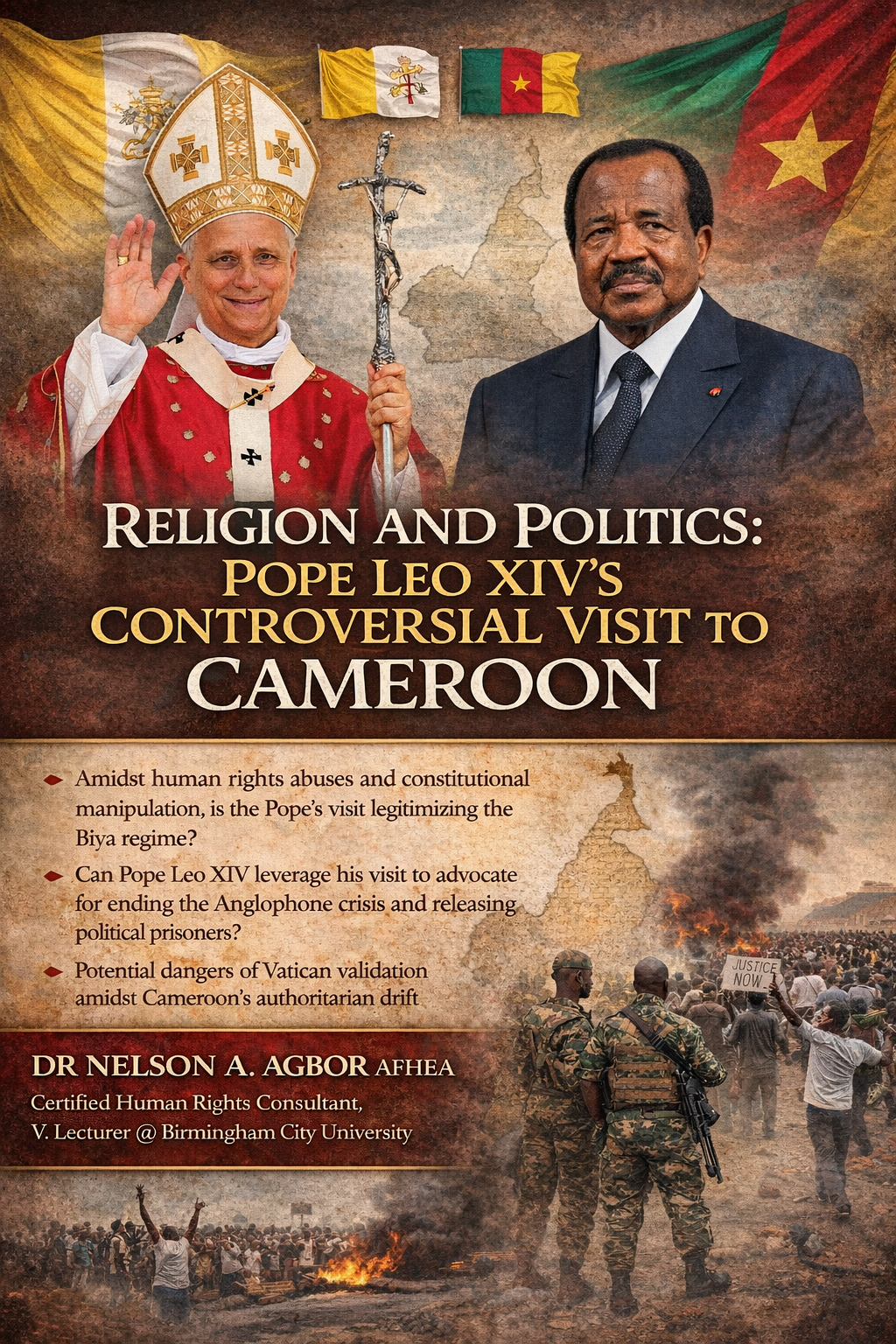
The eminent visit of Pope Leo XIV to Cameroon takes place amid a highly charged political and human rights context that demands rigorous scholarly scrutiny. While papal diplomacy traditionally emphasises pastoral care, reconciliation, and moral guidance, such visits are never politically neutral. In Cameroon, where state authority has long been concentrated under Paul Biya, the symbolic capital of a papal visit risks being appropriated by the regime to reinforce its legitimacy, particularly amid mounting domestic and international criticism.
Cameroon’s political landscape is marked by extraordinary continuity of executive power, with Biya in office since 1982. This longevity has been accompanied by what scholars describe as entrenched neopatrimonial governance structures, characterised by elite capture, weakened institutional accountability, and constrained political pluralism. Recent developments, including controversial constitutional manoeuvres and the unilateral extension of mandates for elected representatives, have intensified concerns about democratic backsliding and the erosion of the rule of law. These dynamics create a fraught backdrop against which any high-profile international visit must be critically evaluated.
Central to this analysis is the ongoing Anglophone crisis, a protracted conflict rooted in historical, linguistic, and legal grievances. Since 2016, tensions between the central government and Anglophone regions have escalated into armed confrontation. Reports document widespread abuses by both state forces and separatist groups, including extrajudicial killings, torture, arbitrary detention, and the destruction of civilian property. The humanitarian consequences are severe, with hundreds of thousands displaced and millions in need of assistance. The persistence of this crisis underscores the failure of state-led dialogue mechanisms and raises urgent questions about accountability and justice..
In parallel, political repression remains a salient feature of Cameroon’s governance. Opposition actors, including members of the Cameroon Renaissance Movement, have repeatedly alleged systemic violations of civil and political rights. Arrests of political opponents, restrictions on assembly, and limitations on press freedom create an environment in which dissent is both risky and constrained. These patterns align with broader findings from international human rights organisations, which point to a culture of impunity and weak judicial oversight.
Against this backdrop, the papal visit takes on a dual character: it is both a pastoral mission and a geopolitical event. Historically, papal diplomacy has oscillated between prophetic critique and cautious engagement. In the Cameroonian context, the risk is that the visit may be instrumentalised by the regime as an endorsement of its authority. State-controlled narratives could frame the visit as evidence of international approval, thereby obscuring ongoing abuses and reinforcing the status quo.
This risk is not merely theoretical. Authoritarian and semi-authoritarian regimes frequently leverage symbolic interactions with global figures to consolidate legitimacy. The Pope, arguably one of the most influential moral authorities in the world, could be presented domestically as a validation of governmental stability and international respectability. Such a framing would be particularly potent in a context where electoral credibility and institutional independence are widely contested.
However, the papacy also wields a distinctive form of soft power rooted in moral legitimacy rather than coercive capacity. This positions the Pope as a potentially transformative actor, capable of articulating normative standards that transcend national politics. The visit to Cameroon, particularly the planned engagements in conflict-affected regions such as Bamenda, provides a critical platform for addressing the Anglophone crisis and advocating peace. The effectiveness of this intervention will depend on the clarity, specificity, and courage of the Pope’s public messaging.
A key expectation is that the Pope should explicitly call for an end to hostilities in the Anglophone regions. General appeals for peace, while symbolically important, may be insufficient in the face of entrenched violence. Instead, a robust intervention would entail acknowledging the specific grievances of affected populations, condemning documented abuses, and urging inclusive dialogue mechanisms that go beyond state-controlled processes. Such an approach would align with the Church’s broader commitment to human dignity and social justice.
Equally pressing is the issue of political prisoners. Calls for their release have become a focal point of advocacy at home and in the diaspora, reflecting broader concerns about the criminalisation of dissent. The Pope’s intervention on this matter would carry significant weight, particularly if framed within the Church’s teachings on human rights and the sanctity of conscience. By foregrounding this issue, the papacy could help shift both domestic and international discourse towards accountability and reform.
The constitutional dimension of the current political crisis further heightens the stakes of the visit. Proposals perceived as enabling dynastic succession or the consolidation of executive power, such as creating a vice-presidential role subject to presidential discretion, have generated widespread apprehension. These developments raise fundamental questions about the future of constitutionalism in Cameroon. A papal critique of such measures, grounded in the principles of subsidiarity and democratic participation, would reinforce the normative framework necessary for sustainable governance.
Importantly, the Pope must navigate the delicate balance between diplomatic engagement and prophetic witness. Excessive caution risks complicity, while overt confrontation may limit access and influence. Nonetheless, historical precedents, from Pope John Paul II’s role in Eastern Europe to Pope Francis’s advocacy for global justice, demonstrate that papal interventions can be both principled and effective when grounded in moral clarity.
In conclusion, Pope Leo XIV’s visit to Cameroon marks a critical juncture at the intersection of religion, politics, and human rights. While the potential for regime legitimisation is real and significant, so too is the opportunity for meaningful moral intervention. The visit’s ultimate impact will depend on whether the Pope exercises his authority as a neutral observer or as an active advocate for justice. In a context marked by conflict, repression, and constitutional uncertainty, neutrality is itself a political stance. The demands of the moment call for a more assertive engagement, one that prioritises peace, accountability, and the fundamental rights of all Cameroonians.
Dr Nelson A. Agbor AFHEA
Certified Human Rights Consultant
V. Lecturer @Birmingham City University.




