
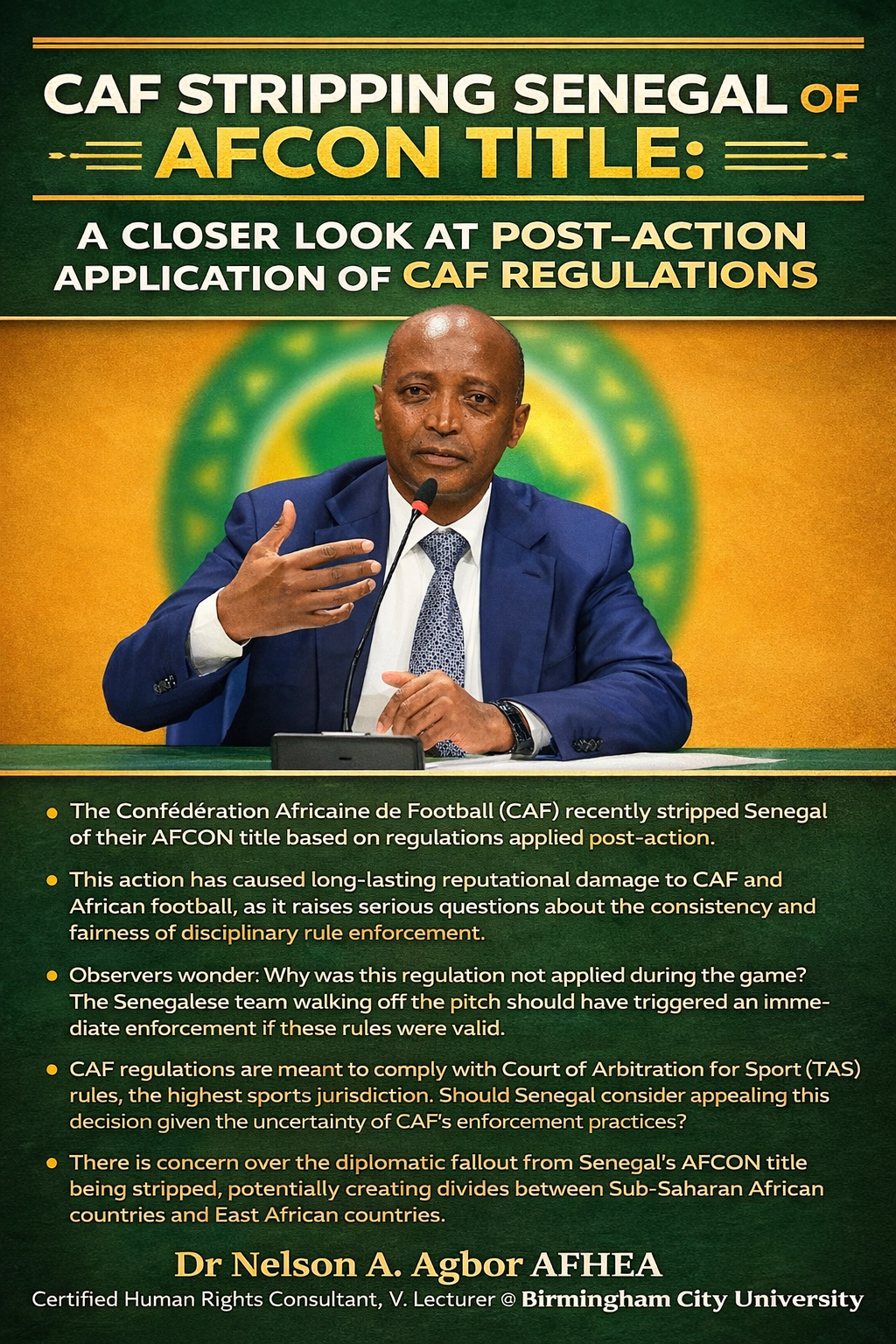
The Confederation of African Football (CAF) Appeals Board’s decision in March 2026 to strip Senegal of its Africa Cup of Nations (AFCON) title marks one of the most contentious governance interventions in modern African sport. Senegal initially secured a 1–0 victory over Morocco in extra time in the final played in Rabat, but the result was retroactively overturned and recorded as a 3–0 forfeit in favour of Morocco. This ruling was based on the application of Articles 82 and 84 of the CAF regulations, which penalise teams that leave the field of play without the referee’s authorisation. While procedurally defensible within the regulatory framework, the retrospective enforcement raises significant questions regarding legal consistency, institutional legitimacy, and the governance of African football.
From a regulatory perspective, CAF’s decision is consistent with established disciplinary regulations. Article 82 explicitly considers a team that refuses to play or leaves the field as having forfeited the match, while Article 84 provides the procedural basis for awarding a 3–0 defeat. Senegal’s temporary walk-off—lasting approximately 14–16 minutes in protest against a contentious penalty decision constituted a prima facie breach of these provisions. CAF’s Appeals Board thus acted within its statutory authority in applying these rules retrospectively. However, the key issue is not the existence of the regulation but its timing: the sanction was not enforced during the match itself, allowing play to continue and conclude under normal sporting conditions.
This temporal inconsistency reveals a fundamental governance flaw. If the walk-off had constituted an immediate forfeiture under CAF regulations, the match should have been ended promptly by the referee after the infraction. Instead, the referee allowed the game to continue, Senegal resumed play, and ultimately won on the field. The subsequent retrospective reversal creates a dual reality, one sporting and one administrative, that undermines the principle of legal certainty in sport. Such post-event enforcement risks damaging trust among stakeholders, as outcomes seem influenced not only by play but also by later reinterpretation. In this context, CAF’s approach contrasts with the expectation of immediate enforcement found in most football disciplinary systems.
The reputational consequences for CAF and African football are likely to be long-lasting. The decision has already provoked widespread backlash, accusations of inconsistency, and suspicions of political influence within African football governance. By overturning a completed final months after its conclusion, CAF risks projecting an image of institutional instability and procedural arbitrariness. This is especially damaging as African football strives to enhance its global credibility, attract investment, and strengthen its regulatory institutions. The perception that results can be altered after the fact may discourage commercial partners and undermine confidence among players, federations, and supporters alike.orters alike.
Should Senegal proceed with its stated intention to appeal to the Court of Arbitration for Sport (CAS/TAS), the case would enter the highest jurisdiction in international sport. CAS jurisprudence generally upholds the strict application of competition rules, particularly when regulations are clear and consistently enforced. CAF could therefore argue that its decision is legally sound under the principle of “strict liability” in sporting regulations. However, Senegal may respond on procedural grounds, highlighting the failure to enforce the rule during the match and the principle of legal certainty. CAS has, in past cases, considered whether governing bodies acted proportionately and consistently. Thus, while CAF’s legal position is defensible, it is not without challenge.
Finally, the wider geopolitical and diplomatic consequences of this dispute cannot be overlooked. The controversy risks worsening regional tensions within African football, especially between sub-Saharan federations and North or East African power blocs. Allegations of unequal influence, already present in CAF politics, could become more severe if the decision is seen as favouring certain regions or federations. A CAS appeal by Senegal might deepen these divisions, turning what is a sporting dispute into a continental governance crisis. In the long term, this incident could trigger calls for reform within CAF, such as clearer protocols for in-match enforcement and increased transparency in appellate decision-making, to rebuild trust in African football’s institutional integrity.
Dr Nelson A. Agbor AFHEA
Certified Human Rights Consultant
V. Lecturer @Birmingham City University.




