
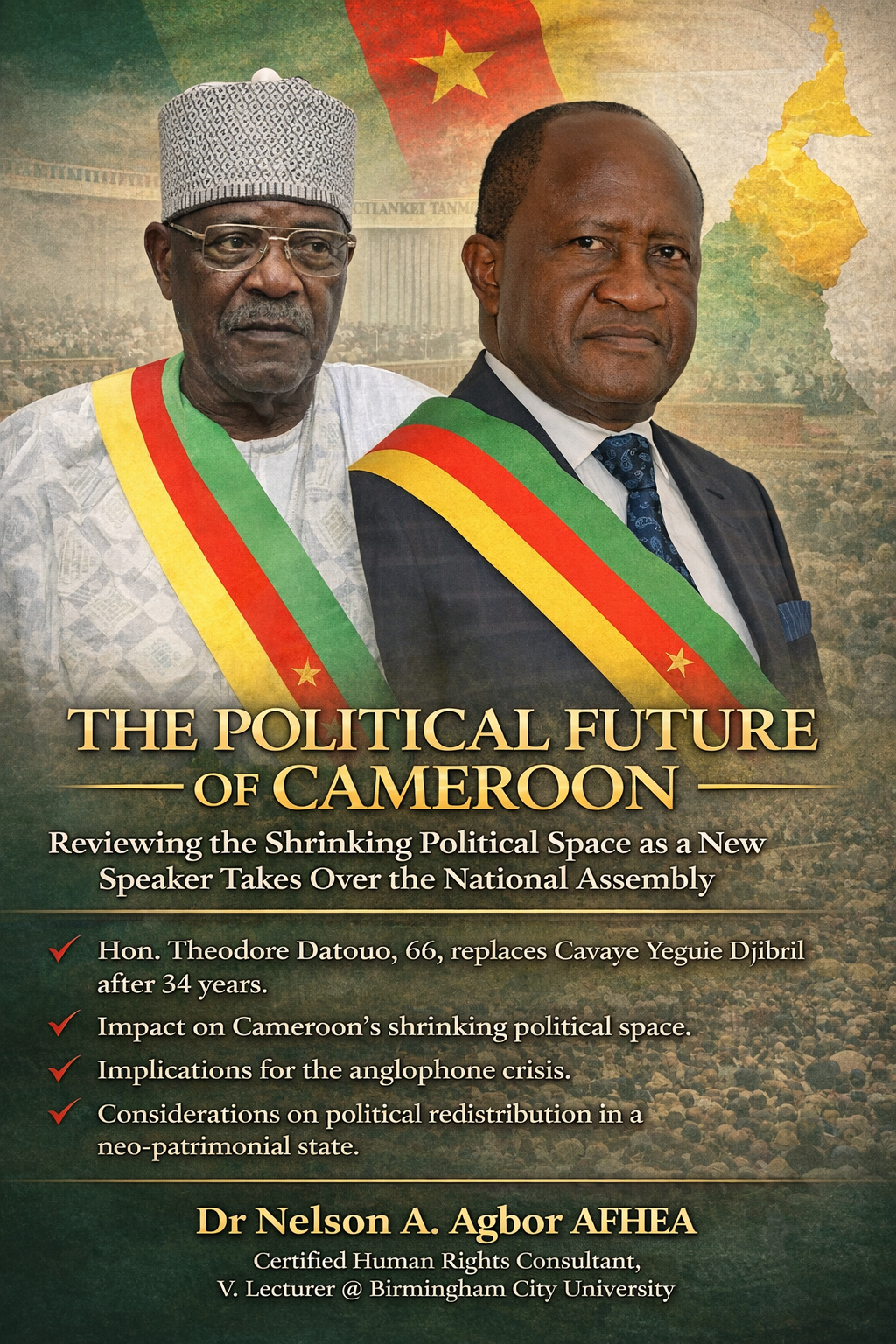
The replacement of Hon. Théodore Datouo as Speaker of Cameroon’s National Assembly, succeeding Hon. Cavaye Yeguie Djibril after more than three decades in office, marks a potentially significant moment in the country’s political trajectory. Cavaye, who had presided over the Assembly since 1992, embodied institutional continuity within a regime characterised by longevity and centralised authority. His tenure coincided with the consolidation of executive dominance under President Paul Biya and the entrenchment of the ruling Cameroon People’s Democratic Movement (CPDM). The emergence of Datouo, a relatively younger figure within the same political establishment, may thus be interpreted less as a rupture than as a controlled transition within an enduring system of power.
From a neo-patrimonial perspective, this leadership change can be seen as part of a broader strategy of elite circulation rather than systemic reform. Cameroon’s political system has long operated through patron-client networks, where access to state resources is mediated by loyalty to the ruling elite. In such systems, institutional offices such as the Speakership serve not only legislative functions but also distributive roles, allocating political and economic benefits to key constituencies. The replacement of a long-serving political figure may therefore reflect internal recalibration within the ruling coalition, aimed at maintaining regime stability by renewing elite legitimacy without fundamentally altering governance structures.
The implications for Cameroon’s declining political space remain uncertain. On one hand, the departure of a figure synonymous with institutional inertia might open up opportunities for modest procedural reforms or generational renewal within parliament. However, given the CPDM’s overwhelming dominance in the National Assembly, which holds a substantial majority of seats, any meaningful liberalisation remains limited by the structural imbalance of power. Furthermore, the legislature has historically operated as a rubber-stamp body, with limited autonomy from the executive. Unless Datouo adopts a more independent parliamentary role, the change in leadership is unlikely to significantly expand political freedoms or opposition participation.
The anglophone crisis presents a more complex landscape in which the Speakership transition might have indirect effects. The crisis, rooted in longstanding grievances over marginalisation in the English-speaking regions, has worsened due to the state’s centralised governance model and resistance to federalism. Under Cavaye, the National Assembly largely maintained a unitary-state narrative, often dismissing or delegitimising separatist demands. A new Speaker could, in theory, promote more inclusive legislative dialogue or support decentralisation measures. However, given the regime’s historical stance and the securitised nature of the conflict, meaningful policy changes are unlikely to come solely from parliamentary leadership. The crisis remains more deeply connected to executive decision-making and military strategy than to legislative initiatives.
Political redistribution within Cameroon’s neo-patrimonial system is another critical aspect of this transition. Leadership changes often indicate shifts in patronage distribution, as new officeholders bring their own networks and regional loyalties into positions of influence. Datouo’s appointment may therefore modify the balance of power among regional elites, potentially reallocating access to state resources and political opportunities. Such redistribution can act as a mechanism for regime resilience, enabling the ruling party to co-opt emerging elites while retaining overall control. However, it may also spark intra-elite competition, especially if excluded factions see the transition as unfavourable to their interests.
In conclusion, the appointment of Théodore Datouo as Speaker marks a moment of controlled change within a deeply rooted political system. While it may hold symbolic significance in signalling a generational transition, its real impact on political liberalisation, conflict resolution, and governance reform is likely to be limited. Cameroon’s neo-patrimonial structure, along with the dominance of the ruling party and the centralisation of executive power, restricts the transformative potential of such institutional shifts. Ultimately, Cameroon’s political future will depend less on changes in parliamentary leadership and more on broader structural reforms that address the fundamental dynamics of power, representation, and state legitimacy.
Dr Nelson A. Agbor AFHEA
Certified Human Rights Consultant
V. Lecturer @Birmingham City University.




